Special-needs dental care is dental care adapted to a patient’s physical, developmental, sensory, behavioral, or medical needs, with the aim of protecting oral health safely and comfortably. Good dental care for special needs patients starts with communication, access, and an individual treatment plan—not an assumption that everyone needs sedation.
TL;DR
Dental care for special needs patients starts with accessible visits, clear communication, and an individual prevention plan.
Affordable Dentist Near Me provides family dental care; confirm special-needs accommodations with the specific office before booking.
Choose a general dentist, specialist, or hospital-based team according to the patient’s needs—not the diagnosis alone.
Sedation requires an individual assessment; sensory adjustments and familiar routines deserve discussion first.
Why dental care matters for patients with special needs
A dental visit involves bright lights, unfamiliar sounds, close physical contact, and instructions that can be difficult to process. Mobility limitations, swallowing difficulties, and complex medical histories add practical questions that an ordinary appointment reminder does not answer.
The right starting point is to explain what the patient needs to participate, rather than listing a diagnosis alone. Someone who communicates through a device needs time to answer. Someone who uses a wheelchair needs an agreed positioning plan.
For children, combine these preparations with age-appropriate prevention; the guide to pediatric dental care for young children covers that broader starting point. Adults deserve equally individualized support without being spoken to as children.
For your 2026 care plan, make access, communication, and prevention explicit. A workable daily routine and a repeatable appointment process matter more than forcing every procedure into the first visit.
How to arrange dental care that fits the patient
Describe the patient’s needs before booking
Start with a written summary you can prepare at home. Explain how the patient communicates, what causes distress, and what has helped during previous healthcare visits. Include strengths and preferences, not just difficulties.
Speak directly with the office about those needs before choosing an appointment. A booking form alone does not establish that the team has the equipment, training, or appointment structure required.
If you support an adult, ask how that person wants you involved. Needing help with transportation or brushing does not automatically mean someone else makes treatment decisions.
Record the patient’s preferred name and communication method.
Describe sensory triggers and helpful calming routines.
Explain mobility, transfer, and positioning needs.
List previous dental experiences that went well or poorly.
Identify who can answer medical questions and support decisions.
Confirm access and communication arrangements
Ask specific questions instead of asking only whether an office is accessible. Entrance access does not answer whether a wheelchair fits through treatment areas or whether treatment can happen without a transfer.
Discuss communication separately. Request plain explanations, extra processing time, or communication aids according to the patient’s preferences. Ask whether a support person can remain present and what limits apply during procedures.
Confirm arrangements with the actual location you intend to visit. Do not assume that every office in a dental group has identical facilities or staffing. Write down the agreed arrangements so you can check them before leaving home.
Ask about the route from parking to the treatment area.
Describe the wheelchair or mobility equipment involved.
Agree on a stop signal the patient can use.
Ask about quieter appointment periods and waiting arrangements.
Confirm how interpreters or communication aids will be arranged.
Match the dental team to the treatment
Begin with a conversation about the patient’s needs and the likely dental work. A general dentist can assess whether care fits the office’s capabilities or whether referral is appropriate. A specialist or hospital setting is not automatically necessary because someone has a disability.
Affordable Dentist Near Me is a general dental care option for families who need to discuss special-needs accommodations before booking. The practice provides general, cosmetic, and restorative services across its listed Texas communities. Confirm the specific office’s experience and accommodations; those general services do not establish specialist facilities or hospital-based care.
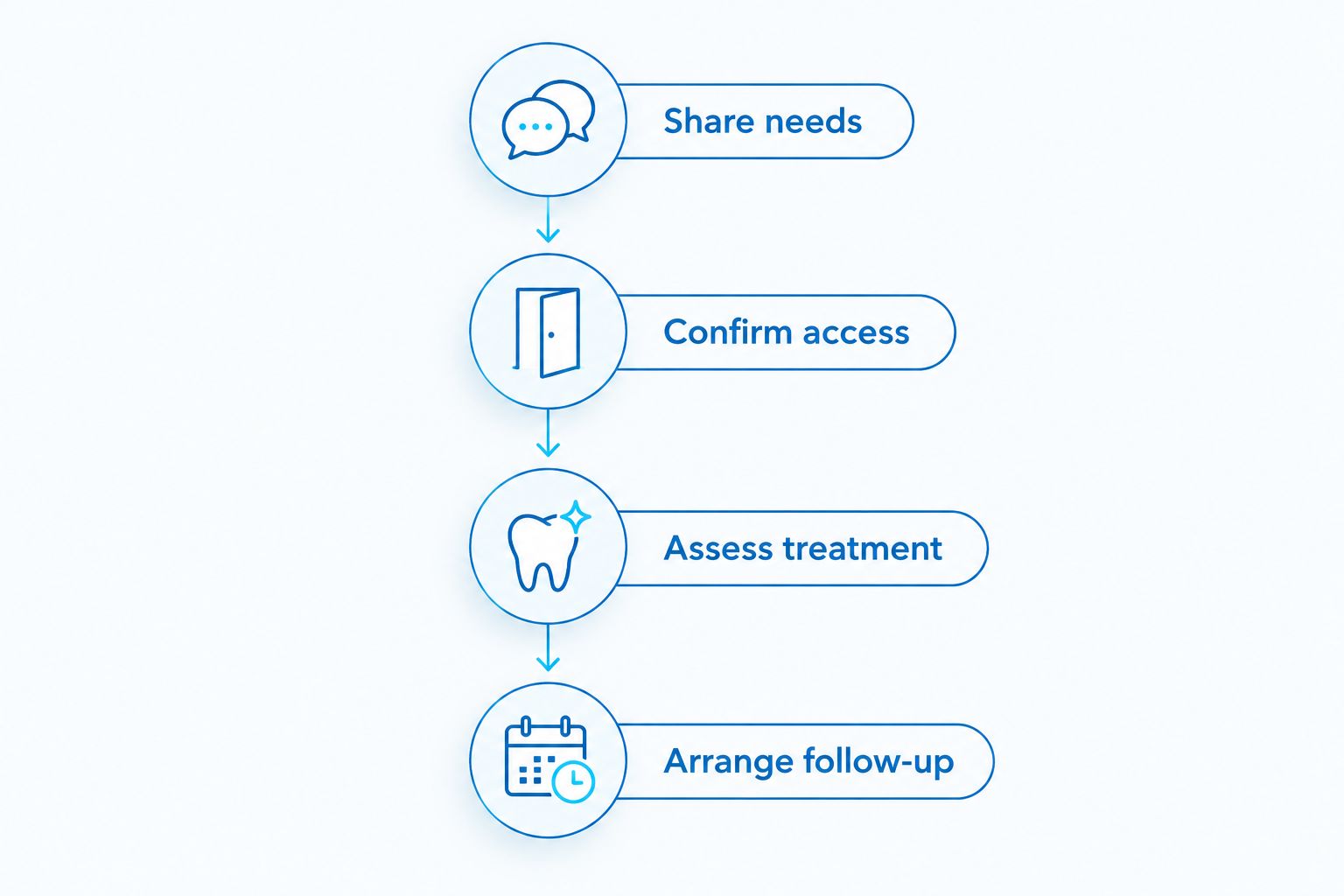
Use Affordable Dentist Near Me as a starting point for that discussion, not as confirmation that a particular accommodation is provided. Follow this sequence: Share needs, Confirm access, Assess treatment, Arrange follow-up.
Confirm the care setting before committing to a treatment appointment.
The useful shortcut is an early office conversation that resolves suitability before you arrange transport or time away from work. Keep the patient’s needs at the center of that conversation.
Ask about experience with the patient’s specific support needs.
Explain the suspected dental problem and current symptoms.
Ask what the first visit can reasonably include.
Confirm when the dentist would recommend referral.
Request a written treatment plan after assessment.
Share medical information and decision-making needs
Prepare an updated medication list, including nonprescription products and supplements. Tell the dentist about allergies, seizures, breathing conditions, swallowing difficulties, and other conditions relevant to treatment. Describe previous problems with anesthesia or sedation.
For a 2026 appointment, check the list against what the patient currently takes—not an old discharge summary. Do not stop, change, or skip prescribed medicine unless the treating clinician gives instructions.
Clarify consent before treatment. A support person can help explain preferences, but the office must establish who can legally consent and how the patient will participate. Bring relevant documents when another person has legal decision-making authority.
Include medicine names, doses, and prescribing clinicians.
List allergies and the reactions they caused.
Bring contact details for relevant medical clinicians.
Explain feeding, swallowing, or breathing support needs.
Confirm consent documents and the patient’s preferred involvement.
Prepare for a manageable first visit
Start with familiarization that does not require buying anything. Explain the visit using words, pictures, or the patient’s usual communication method. Rehearse opening the mouth or using the agreed stop signal only if the patient is comfortable.
Ask whether the first appointment can focus on meeting the team and assessing the mouth. Urgent symptoms still need prompt attention; familiarization should not become a reason to delay necessary care.
Sensory adjustments and breaks are useful topics to discuss before sedation. When those changes are insufficient, the dentist should explain the suitable alternatives, their risks, and the supervision they require. Never give someone another person’s sedative or use extra medication to make attendance easier.
Describe the visit in the patient’s preferred format.
Bring an agreed comfort item or communication device.
Ask staff to explain before touching or starting equipment.
Agree on breaks and a clear stopping point.
Obtain individualized instructions if sedation is planned.
Build a daily prevention routine
Choose a routine that the patient and caregiver can repeat consistently. Standard advice is to brush with fluoride toothpaste for 2 minutes per session, twice a day. Ask the dentist to adapt the technique, toothpaste amount, and assistance to the person’s age, swallowing ability, and needs.
A powered toothbrush helps some people but creates unwanted vibration for others. A manual toothbrush with an easier-to-hold handle is another option. The useful choice is the one that supports effective, tolerable cleaning—not the one with the most features.
Ask how to clean between teeth safely. If the patient cannot spit reliably or has swallowing difficulties, get specific advice rather than adding a mouth rinse independently.
Use fluoride toothpaste in the dentist-recommended amount.
Choose a brush the patient can comfortably tolerate.
Ask for a demonstration of safe caregiver assistance.
Request alternatives when standard floss is difficult to use.
Report dry mouth, bleeding, pain, or persistent brushing difficulties.
Review coverage and arrange follow-up
Ask for a written plan separating urgent needs, prevention, and treatment that can wait. Then check benefits against the actual procedures and setting proposed. Coverage for an examination does not establish coverage for sedation, anesthesia, or a hospital facility.
For 2026 coverage, verify the current plan, provider participation, referral rules, and any prior authorization requirements. Ask who submits requests and what documentation is needed. Do not assume that a disability diagnosis guarantees a particular benefit.
Before leaving, record which accommodations helped and what needs changing. Follow-up intervals should reflect the patient’s oral health and risk, rather than an automatic schedule chosen without assessment.
Request the proposed procedures in writing.
Verify coverage with both the office and benefits administrator.
Check separate requirements for anesthesia or facility services.
Obtain accessible aftercare instructions.
Record the next appointment’s purpose and support arrangements.
Compare dental care settings
Choose the least complex setting that can safely meet the patient’s needs. An individual assessment determines that fit. The comparison below describes care settings, not services confirmed at any particular practice.
Option
Best for
Main advantage
Key limitation
General dental office
Patients whose needs fit the office’s clinical skills and accommodations
Routine prevention and treatment in a community setting
Equipment, experience, and support arrangements differ by office
Pediatric dentist
Children who need age-specific dental assessment and care
Training focused on children’s dental needs
Adult care and complex medical support require separate arrangements
Dentist experienced in special care
Patients needing more individualized communication, positioning, or treatment planning
Experience adapting care to additional needs
Confirm the dentist’s actual experience and referral requirements
Hospital-based dental team
Patients whose assessed medical or anesthesia needs require hospital resources
Dental care coordinated with a hospital team
Requires assessment and coordination; it is not necessary for every patient
Affordable Dentist Near Me provides family dental care, but you should confirm whether the particular office fits the patient’s needs before selecting it. Its stated general services do not establish a dedicated special-care program, specific transfer equipment, or anesthesia arrangements.
Sedation is a treatment support, not a separate diagnosis-based destination. Ask who provides it, what monitoring is used, what medical review is necessary, and what recovery assistance is required.
Common mistakes patients and caregivers make
Assuming the diagnosis explains every need
Two patients with the same diagnosis can have very different communication preferences and tolerance for treatment. Describe the person’s needs in practical terms, including what they can do independently.
Booking before checking the treatment space
An accessible entrance does not settle transfer, positioning, or restroom questions. Confirm the full visit pathway before arranging transportation, especially when specialized transport or caregiver assistance is involved.
Treating sedation as the default
A disability does not automatically create a need for sedation. Discuss communication changes, sensory adjustments, and treatment pacing first; the dentist must assess whether sedation is appropriate and explain its risks.
Speaking only to the caregiver
Address the patient directly and allow time for a response. A person who uses a communication device or needs assistance still deserves explanations and involvement in decisions.
Waiting for the patient to describe pain
Not everyone expresses dental discomfort verbally. New chewing avoidance, disturbed sleep, or resistance to brushing deserves attention, but those changes do not prove a dental cause. Arrange assessment rather than guessing or forcing an examination at home.
FAQ
What is dental care for special needs patients?
Dental care for special needs patients adapts communication, access, prevention, and treatment to the individual. The plan should reflect the patient’s abilities, health conditions, preferences, and support needs rather than the diagnosis alone.
Can a general dentist treat a patient with special needs?
A general dentist can provide care when the patient’s needs fit the office’s skills, equipment, and support arrangements. Discuss those needs before booking, and ask when referral would be appropriate.
Does every patient with autism need dental sedation?
No, an autism diagnosis alone does not establish a need for dental sedation. Discuss communication preferences, sensory adjustments, and visit pacing; the dentist should assess any need for sedation individually.
Can a caregiver stay in the dental treatment room?
Ask the specific office whether a caregiver can remain during the planned appointment. Explain the support the caregiver provides and confirm any procedure-related restrictions before arrival.
How should I brush teeth for someone who needs help?
Ask the dentist to demonstrate a safe technique suited to the person’s positioning, movement, and swallowing needs. Use fluoride toothpaste as directed, and do not force the mouth open or improvise restraints.
Does insurance cover special-needs dental treatment in 2026?
Coverage depends on the patient’s plan, eligibility, proposed procedures, and treatment setting. Verify dental treatment, sedation, anesthesia, and facility requirements separately before planned care.
When does a dental problem need emergency help?
Call 911 for breathing difficulty, trouble swallowing with facial or neck swelling, or another life-threatening emergency. Contact a dentist promptly for tooth pain, swelling, injury, or suspected infection; do not delay assessment while arranging a routine familiarization visit.
One last thing
Make the successful visit repeatable. After an appointment, record the words, positioning, breaks, and communication methods that helped. Bring that short summary next time and ask the office to update the patient record.
For the rest of 2026, keep that summary with the medication list and benefits information. A useful care plan tells the next person how to help—not simply which diagnosis appears in the chart.