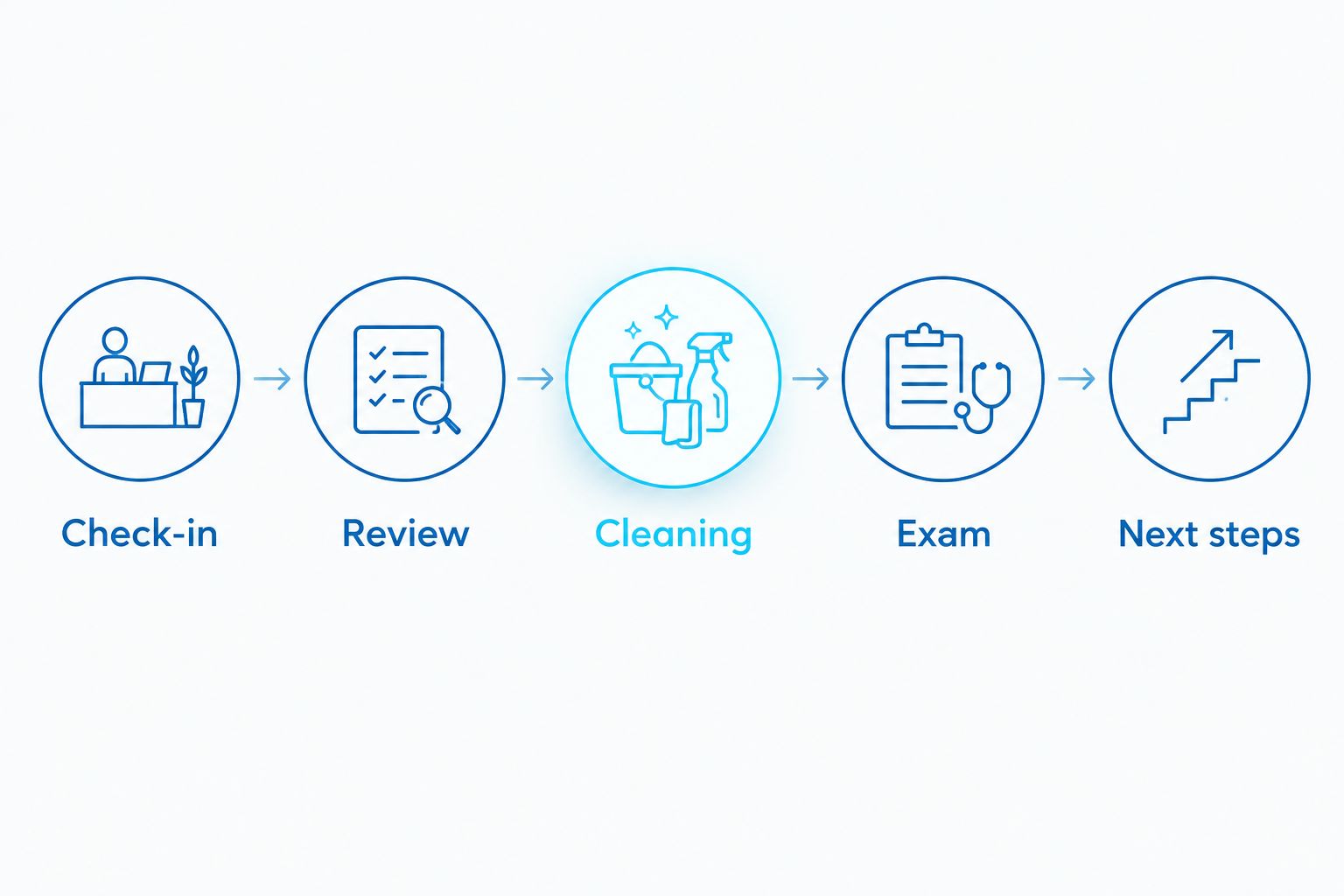
Plan for about 60 minutes for a routine dental cleaning appointment; a common range is 30–60 minutes in 2026. Check-in, a dental exam or X-rays can extend the visit beyond the cleaning itself. If your dentist recommends treatment for gum disease, ask how much time to reserve because that is a different appointment from a routine cleaning.
TL;DR
A routine dental cleaning appointment usually takes 30–60 minutes; plan for about 60 minutes in 2026.
Check-in, an exam or X-rays can add time beyond the cleaning itself.
A gum disease treatment visit is different from a routine cleaning; confirm which one is booked.
Affordable Dentist Near Me serves families seeking general dental care in Fort Worth, Dallas, Houston, Waco, Grand Prairie and Crowley.
How long does a dental cleaning appointment take?
Reserve about 60 minutes for a routine cleaning in 2026. The 30–60-minute range is a planning guide, not a promise that every visit will finish within it. The time depends on what your appointment includes, so ask the office whether the quoted length covers check-in, the cleaning and a dentist's exam.
A routine visit usually follows these steps. Not every office schedules them in the same order:
Check-in: Confirm your details and tell the team about any changes to your health or medications.
Review: Discuss concerns such as bleeding gums, tooth pain or a spot you want examined.
Cleaning: The dental professional removes buildup, polishes your teeth and discusses home care.
Exam: A dentist checks your teeth and gums if an exam is part of the visit. X-rays may also be recommended.
Next steps: Ask whether you need follow-up care and what type of appointment to book.
The cleaning is only one part of that sequence. If you have to return to work, pick up a child or arrange transportation, schedule around the whole visit, not just the time spent in the chair. Tell the office about a firm departure time before you book; that gives the team a chance to explain whether the planned visit fits.
Why this matters
In 2026, the useful question is not only how long a dental cleaning takes. It is what the office has booked for you. A routine cleaning, a first visit with an exam and a visit to address gum disease do not have the same scope. Treating them as interchangeable can leave you with too little time or the wrong expectations.
Cleaning frequency is a separate decision from appointment length. If you are trying to plan future visits, read how often you should get a professional dental cleaning and ask your dentist what schedule fits your oral health. Do not assume that a familiar appointment length means the same care is appropriate at every visit.
Routine cleaning or gum treatment: which visit is booked?
Both options involve your teeth and gums, but they answer different needs. A routine cleaning is best for preventive care when your dentist has not recommended gum disease treatment. Treatment for gum disease is best discussed after a dentist evaluates your gums and explains the recommended care.
Visit
Best for
What to expect
Advantage
Limitation
Routine cleaning
Preventive care when no gum treatment has been recommended
Cleaning, with an exam or X-rays if they are part of the booked visit
The 30–60-minute range helps you plan
The full visit can take longer if other services are included
Gum disease treatment
Patients whose dentist has recommended treatment for gum disease
Care based on the dentist's findings
Addresses a concern that a routine cleaning alone may not resolve
Do not use the routine-cleaning time estimate; ask for a visit-specific plan
The table is a scheduling distinction, not a way to diagnose your gums. Bleeding when you brush, persistent gum discomfort or a previous recommendation for gum treatment are reasons to describe your concern when you call. The office can explain what type of appointment to request; a dentist can determine what care you need after an evaluation.
Do not book a routine cleaning as a substitute for a recommended gum treatment visit. If you are unsure which appointment you need, say so before scheduling. That short conversation is more useful than trying to fit an unfamiliar procedure into a 60-minute calendar slot.
What happens during the cleaning portion?
The dental professional removes plaque and hardened buildup from your teeth, then polishes them. You can also ask about areas that are difficult to keep clean at home. If you have a sensitive spot, say where it is before the cleaning starts so the team knows what concerns you.
The cleaning portion does not automatically include every service that can happen at a dental visit. An exam is a check of your oral health by a dentist. X-rays provide images when they are recommended. Because offices book visits differently, neither should be assumed to be included in, or excluded from, the time you were quoted.
Your home routine matters between appointments, but it does not replace a professional cleaning. Brush for 2 minutes twice a day and clean between your teeth daily, consistent with American Dental Association guidance. If brushing or flossing causes bleeding, mention it during the visit rather than waiting for the cleaning to explain the cause.
A first appointment also gives you a chance to establish what the team needs to know about your health. Bring a list of medications if you take any, and be ready to discuss relevant medical conditions. Sharing that information is part of preparing for care; it is not a reason to guess how long your individual appointment will take.
The cleaning is one part of the booked visit, not necessarily the entire appointment.
Why does a dental cleaning appointment take longer?
Several parts of a visit can change how much time you need to reserve in 2026. Ask which of these are included when you book:
Check-in requirements: A new patient may need to provide information that an established patient has already supplied. Ask whether any forms can be completed before arrival.
Health updates: Changes in medication, medical history or symptoms need to be discussed before care begins.
The condition of your teeth and gums: The dental professional needs to assess what can be addressed during the booked visit. A concern that calls for different care changes the plan.
A dentist's exam: If the appointment includes an exam, leave time for it rather than treating the cleaning as the end of your visit.
X-rays: Ask whether images are expected at this visit; do not assume they are part of every cleaning.
Questions and next steps: A treatment recommendation takes time to explain. Ask for clarification before you leave if the plan is not clear.
These factors are more useful than asking for an exact minute count without describing the visit. Tell the scheduler whether you are a new patient, whether you have a concern and whether you have been told you need gum treatment. Then ask for the total appointment time, from arrival through checkout.
If your schedule is tight, identify the deadline clearly. The office can tell you what is booked, but it should not have to guess whether you mean 60 minutes in the chair or 60 minutes from the moment you arrive.
How should you prepare for the appointment?
Preparation will not turn every cleaning into a short visit. It will help you give the dental team the information needed to plan the right one. Start with the reason for your visit: preventive cleaning, a specific concern or follow-up after a previous recommendation. Use the same description when you book and when you arrive.
Before the appointment, confirm these details:
Is this booked as a routine cleaning, a first visit or an evaluation of a concern?
Will the visit include a dentist's exam?
Are X-rays expected, or will the dentist decide whether they are needed?
What is the estimated total time to reserve, including check-in?
Is there information the office wants you to provide beforehand?
If you have dental coverage, bring the details the office requests and ask what it can verify before the appointment. Coverage questions are separate from the time needed for care, but resolving them early keeps the purpose of the visit clear. If you do not have coverage, ask about the visit's scope before agreeing to additional care; do not assume every service is part of a routine cleaning.
You do not need to diagnose your own gum health to make the call. Describe what you notice in plain language: bleeding when you brush, soreness, a loose tooth or pain in a particular area. A cleaning appointment is not a replacement for telling the team about a symptom that needs attention.
Can you fit a dental cleaning into a work break?
Do not count on fitting the whole visit into a break shorter than 60 minutes. Even when a routine cleaning falls within the 30–60-minute range, check-in, an exam or X-rays can add time. Your travel time is separate again.
If you need to leave by a certain time, tell the office when scheduling and repeat it at check-in. Ask whether the booked services can be completed within that window. When the answer is no, choose an appointment time that lets you receive the planned care without rushing the conversation about your teeth and gums.
The same rule applies when you are scheduling for a child or another family member. Confirm who is booked, what each person needs and how much time the office asks you to reserve. One person's routine visit is not a reliable timetable for someone else's exam or treatment.
Is a first dental cleaning appointment longer?
A first visit can take longer than a familiar routine cleaning, because the team may need to review your health history and determine whether an exam or X-rays are appropriate. There is no single additional time that applies to every new patient, so ask the office for the length of the appointment it has booked for you.
If you have not had a cleaning recently, say that when you schedule. It gives the team context without requiring you to decide which type of cleaning you need. A dentist can explain the findings and recommend the next step after an evaluation.
For 2026 planning, distinguish between your first visit with an office and your first cleaning after a long gap. Both are useful details to share, but neither proves that you need gum treatment. Avoid selecting a treatment based on a time estimate alone.
When should you contact the office about timing?
Contact the office before your visit if the appointment description is unclear, you have a new symptom or you cannot stay for the time reserved. Those details affect what the team can plan. They are more actionable than asking whether all dental cleanings take exactly the same amount of time.
Affordable Dentist Near Me is best for families in Fort Worth, Dallas, Houston, Waco, Grand Prairie and Crowley who want general dental care and a clear plan for their visit. Ask Affordable Dentist Near Me which services are included in your booked appointment and how long to reserve. The practice also offers cosmetic and restorative dental care, but those services should not be assumed to be part of a routine cleaning.
A useful scheduling question is: Does this time estimate cover everything I am booked to receive, including an exam if needed? If you have a particular concern, describe it too. That lets the office answer for your appointment rather than for a generic cleaning.
Clarify your dental visit
Ask what is included and how much time to reserve.
A routine dental cleaning appointment commonly takes 30–60 minutes in 2026; plan for about 60 minutes. Check-in, an exam or X-rays can extend the full visit.
Does a 60-minute dental cleaning include an exam?
A 60-minute planning estimate does not confirm that an exam is included. Ask the office which services are booked and whether its time estimate covers the full visit.
Are X-rays part of every dental cleaning appointment?
No, do not assume X-rays are part of every cleaning appointment. Ask whether images are expected at your visit or whether a dentist will decide if they are needed.
Will my first dental cleaning take longer?
A first visit can take longer if the team needs to review your health history, perform an exam or consider X-rays. Ask for the total time reserved for your specific appointment.
Is a deep cleaning the same length as a routine cleaning?
No, do not use the 30–60-minute routine-cleaning range to plan treatment for gum disease. Ask the office what treatment is recommended and how much time its appointment requires.
Can I get a dental cleaning during my lunch break?
Do not rely on a break shorter than 60 minutes for the full visit. Confirm the booked services and allow separate time for travel, check-in and any exam.
What should I tell the office when I book a cleaning?
Tell the office whether you are a new patient, when you last had a cleaning and whether you have pain or gum concerns. Ask what the appointment includes and how long to reserve.
One last thing
The most useful time estimate is not the length of the cleaning tool's work; it is the length of your booked visit. In 2026, start with 60 minutes for a routine appointment, then confirm the plan before putting anything time-sensitive immediately afterward. Affordable Dentist Near Me can explain the scope of an appointment at its practice; only an evaluation can determine whether routine cleaning or other care is appropriate for you.