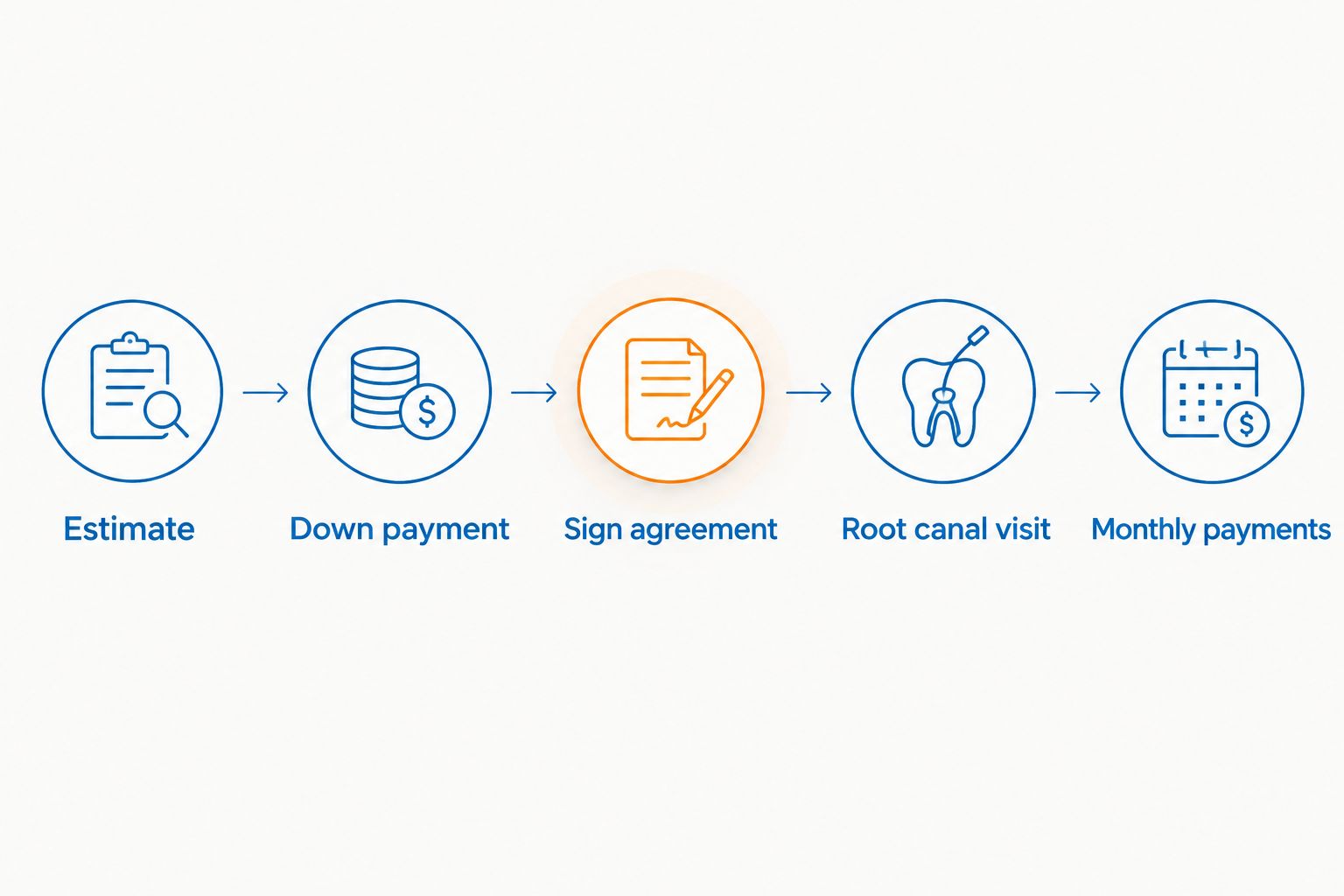
Root canals cost real money, and most patients don't have $700 to $2,000 sitting in checking the week a molar starts throbbing. Instead of skipping the appointment or letting an infection spread, set up an in-house payment plan before you sit in the chair so treatment starts now and the balance splits into payments you can actually make.
TL;DR
An in-house payment plan splits a root canal into monthly installments with no third-party credit check.
Searching cheapest root canal near me in 2026? In-house plans often beat CareCredit once a promo interest period ends.
Book the exam and X-ray first — the down payment and installment amount are calculated off the full written estimate.
Molars usually need a crown after the root canal; confirm in writing whether it’s bundled into the plan before you sign.
CareCredit or Medicaid verification can stack with an in-house plan when one balance is still too much for one budget.
Typical root canal costs, 2026
$700-$1,200
Front tooth root canal, national average
$1,000-$2,000
Molar root canal, national average
Why this matters
A tooth that needs a root canal doesn't wait for payday. Delay treatment past the point of infection and the choice narrows to extraction, and extraction usually costs more long-term once you factor in an implant or bridge to replace the missing tooth.
Affordable Dentist Near Me runs in-house payment plans across its Fort Worth, Dallas, Houston, Waco, Grand Prairie and Crowley locations specifically so a root canal doesn't get postponed over cash flow. The verdict: an in-house payment plan gets a root canal started the same week, with no bank or credit union involved. That's the workflow below.
Before you start
A current exam and X-ray. The office needs to confirm the tooth actually needs a root canal — not an extraction — before quoting a plan.
A government ID and a checking account or debit card. Most in-house plans run on auto-pay, so you'll need a funding source ready at signing.
The gotcha: ask about the crown up front. A molar root canal is almost always followed by a crown, and a plan quoted for "root canal only" leaves that crown as a separate bill weeks later. Get the crown priced into the same written estimate before you sign anything.
Get your treatment estimate
Call the office or request an appointment for the tooth that's bothering you. If you're in pain, ask the front desk to schedule the exam and X-ray for the same visit.
During the exam, the dentist confirms whether a root canal or an alternative fits the tooth. If you want to see how root canal treatment stacks up against pulling the tooth, the root canal vs extraction comparison breaks down both paths before you commit to either one.
Ask the office manager for a written treatment estimate that separates the root canal fee from any crown, medication, or follow-up visit charge.
Expected result: you leave with a single-page estimate itemizing every procedure tied to that tooth, not just the root canal line item.
Set up your in-house payment plan
Ask for the office's Payment Plan Agreement — an internal financing form, separate from a CareCredit or bank application.
Confirm the Down Payment amount and the Monthly Installment figure. Both are calculated off the full written estimate, including the crown if one's needed, not just the root canal fee alone.
Set a preferred payment date and provide a card or bank account for the Auto-Pay Authorization section. Most in-house plans require auto-pay rather than manual monthly check-ins.
Sign the agreement and get a copy before you leave the office.
Expected result: a signed schedule showing every payment date and amount through payoff, in writing, before treatment starts.
The plan is signed before the root canal, not after.
Schedule the root canal and crown visits
Book the root canal appointment. Same-day scheduling is often available the day the plan is signed if there's an opening.
If the tooth needs a crown, schedule that visit two to three weeks later, once the treated tooth has settled.
Confirm the payment schedule lines up with both visits, not just the first one, so you know exactly what's due before each appointment.
Expected result: two appointments on the calendar and a payment plan running quietly in the background until the balance is paid off.
Combine an in-house plan with CareCredit
When the down payment itself is the sticking point, apply for CareCredit to cover just that first payment, then let the in-house plan carry the remaining balance in smaller monthly amounts. This works best for patients who have decent credit but not much cash on hand that week. The CareCredit workflow walks through the application and approval steps in more detail.
How the payment options compare
Option
Credit check
Interest
Best for
In-house payment plan
None
Set at signing, no compounding
Patients who want a fixed schedule with no third party
CareCredit
Yes
Promotional 0% if paid in full within the promo window, deferred interest after
Patients with good credit who can pay off fast
Medicaid (Texas, where eligible)
Income-based eligibility, not credit
None for covered procedures
Eligible low-income patients and children
Pay in full
None
None
Patients who'd rather not carry any balance
In-house payment plan: Buy for most uninsured patients who want predictability without a credit pull. CareCredit: Buy only if you're confident you'll clear the promo balance before deferred interest kicks in. Medicaid: Buy if you're already eligible — it's the cheapest root canal option on this list for those who qualify. Pay in full: Skip unless the cash is already sitting aside; there's no upside to draining savings when a $0-interest in-house schedule exists.
Troubleshooting
Plan application denied. Ask the office manager about a larger down payment or a shorter payoff window — most denials come from the requested monthly amount being too low relative to the balance, not from credit history, since in-house plans skip the credit check entirely.
Missed a monthly payment. Call before the due date. Most in-house plans allow a grace conversation instead of the automatic late fee a credit card would charge.
Crown wasn't in the original quote. Request a revised written estimate before the crown appointment and ask to have the added cost folded into the remaining installments instead of billed separately.
Dental insurance reimburses after treatment. Ask the office to apply the insurance payout as a lump sum against the remaining balance — this shortens the plan instead of just refunding you separately.
Customize your plan
No dental insurance at all changes which combination makes sense. The dental care options for uninsured patients guide covers discount memberships and sliding-scale options that pair with an in-house plan to bring the monthly number down further. If eligibility for state assistance is a question mark, verify that before booking anything.
Start your root canal payment plan
Same-week appointments across Fort Worth, Dallas, Houston, Waco, Grand Prairie and Crowley.
The cheapest option is usually an in-house payment plan through a dental office, since it avoids third-party interest and skips a credit check. Medicaid can be cheaper still for patients who qualify, and paying in full avoids any financing cost if the cash is available.
Does an in-house payment plan check credit?
No. In-house dental payment plans are set up directly with the office and don’t run a credit check the way CareCredit or a bank loan would. Approval is based on the down payment and monthly amount the office and patient agree on.
Is CareCredit or an in-house payment plan better for a root canal?
An in-house plan is better for predictable, interest-free payments with no credit pull. CareCredit works well only if you can pay off the balance inside the promotional 0% window, since deferred interest applies retroactively after that.
How much does a root canal cost without insurance in 2026?
Front-tooth root canals typically run $700 to $1,200 nationally, while molars run $1,000 to $2,000, based on published dental-cost data. A crown afterward adds to the total, which is why a written itemized estimate matters before signing a payment plan.
Can I get a root canal the same day I sign a payment plan?
Often, yes, if the office has same-day openings and the exam and X-ray already confirmed the diagnosis. The payment plan agreement and the treatment appointment can happen in the same visit.
Does Medicaid cover root canals in Texas?
Coverage depends on eligibility and the specific plan; children’s Medicaid dental benefits in Texas are broader than adult coverage. Verify eligibility before assuming a root canal is fully covered.
What happens if I miss a payment on an in-house dental plan?
Call the office before the due date rather than after. Most in-house plans handle a missed payment with a rescheduled charge instead of an automatic late fee, unlike a credit card.
Do I need a crown after every root canal?
Molars almost always need a crown afterward because the tooth structure is weaker post-treatment. Front teeth sometimes get by with a filling instead, which is why the written estimate should specify tooth by tooth.
One last thing
Most patients ask about the root canal fee and forget to ask about the crown until the second bill shows up. Get both priced on the same written estimate before you sign the payment plan — it's the single detail that keeps a two-visit treatment from turning into two separate financial surprises in 2026.