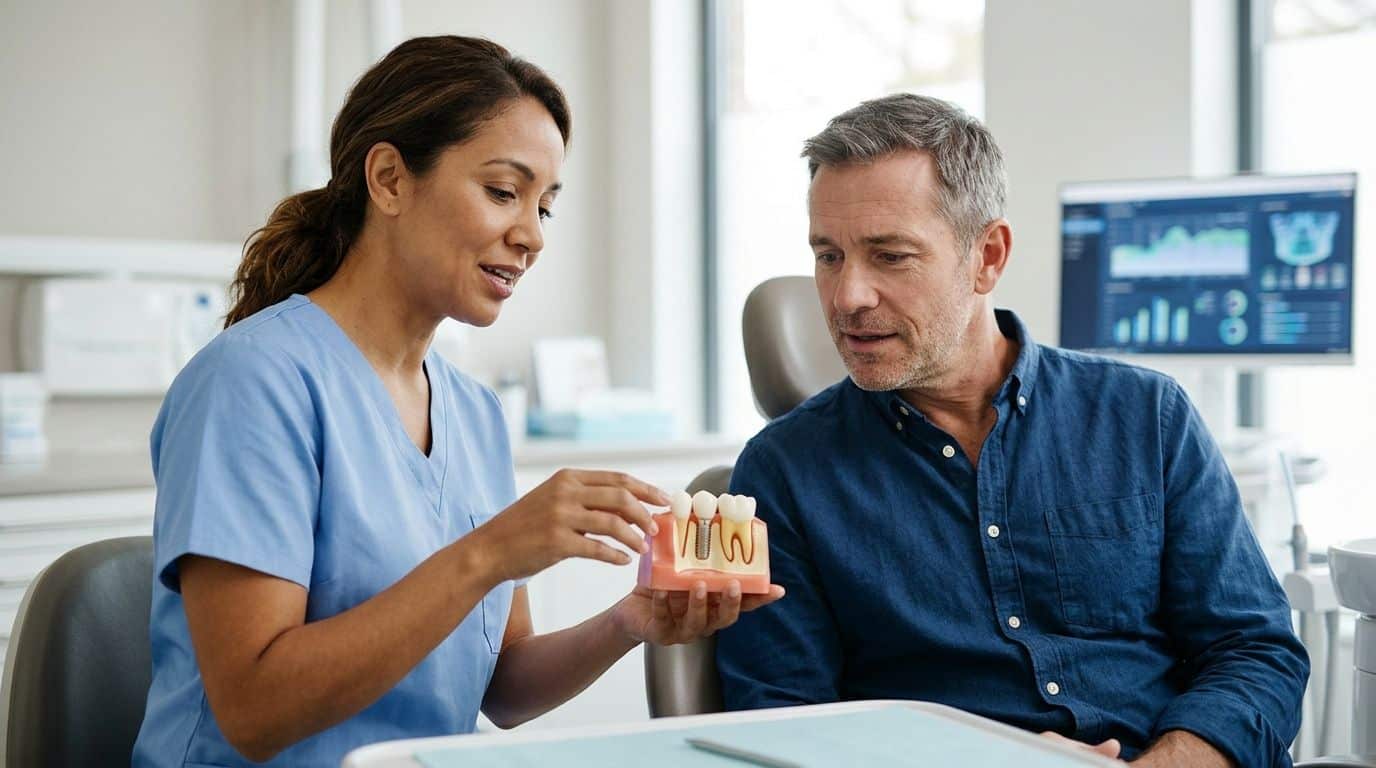
Dental implants with gum disease can be safe after the disease is treated and controlled, but active gum disease needs attention before implant placement. A previous diagnosis does not automatically rule you out; your dentist must assess your gums, remaining bone, overall health, and ability to maintain the implant.
TL;DR
- Dental implants with gum disease require treatment and reassessment before placement; a past diagnosis does not automatically exclude you.
- Bone loss and active inflammation are separate problems, and your implant plan must address both.
- Affordable Dentist Near Me provides general and restorative dental care for families across its Texas locations.
- Implants cannot get cavities, but the gums and bone supporting them still need daily care.
Why this matters
Replacing a missing tooth does not remove the conditions that caused gum disease. Bacteria and inflammation can also damage the tissues supporting an implant, so a successful plan addresses more than the gap in your smile.
For your 2026 treatment plan, put gum health before a surgery date. Start by understanding your diagnosis and the available gum disease treatment options, then ask what findings will show that treatment has worked.
The goal is a stable foundation, not simply an implant that can be placed. You also need a replacement tooth that you can clean and maintain.
Is it safe to get dental implants if you have gum disease?
It is not appropriate to treat uncontrolled gum disease as an acceptable foundation for routine implant placement. Once treatment controls the disease, some people become suitable candidates, including people who previously lost teeth because of periodontitis—the form of gum disease that damages supporting bone.
Your dentist should distinguish current inflammation from damage left behind by earlier disease. Healthy-looking gums alone do not establish that enough bone remains for an implant.
| Gum condition |
What it means for implants |
Best next step |
Important limitation |
| Gingivitis |
Gum inflammation without the supporting bone loss associated with periodontitis |
Best for: treating inflammation before implant planning |
Less bleeding alone does not establish implant readiness |
| Active periodontitis |
Ongoing disease affects the tissues supporting natural teeth |
Best for: gum treatment and reassessment before implant placement |
Ignoring the disease leaves an avoidable risk untreated |
| Treated, stable periodontitis |
Previous disease is controlled, but its history remains relevant |
Best for: individualized implant assessment and ongoing maintenance |
Previous bone loss and future inflammation still require attention |
| Significant bone loss |
The proposed implant site lacks some supporting bone |
Best for: assessing whether additional treatment is appropriate |
Not every site is suitable, and grafting does not guarantee eligibility |
This comparison is a guide to the conversation, not a way to diagnose yourself. An examination, gum measurements, and appropriate imaging establish which situation applies to you.
If you have gingivitis: treat the inflammation first
Gingivitis can usually be reversed with professional care and effective daily cleaning. Your dentist checks for plaque and hardened deposits, explains how to clean the affected areas, and reassesses the gums after treatment.
The advantage is that gingivitis does not involve the bone destruction that defines periodontitis. The limitation is that you cannot reliably distinguish the conditions by how sore your gums feel. Gum disease can progress without substantial pain.
For implant planning in 2026, ask for a diagnosis rather than relying on a reassuring appearance. Bleeding, redness, or swelling deserves assessment even when you can eat comfortably.
If you have active periodontitis: control the disease
Periodontitis requires treatment directed at the infection and inflammation around the teeth. Deep cleaning below the gumline is a common part of care; some people need further treatment or assessment by a gum specialist.
A completed cleaning appointment is not the same as controlled disease. The dentist needs to review how your gums respond and whether deeper areas remain difficult to clean or continue to bleed.
Treatment aims to stop further damage and create a maintainable mouth. It does not automatically replace bone already lost, and it does not make every tooth worth saving. Ask which teeth can be maintained and why an extraction is being recommended before agreeing to remove them.
If your gum disease is stable: assess the implant site
A history of periodontitis does not automatically disqualify you from dental implants. It does make continuing gum care especially important, because people with previous periodontitis have an increased risk of disease around implants.
Your assessment should cover the planned implant site and the rest of your mouth. Leaving untreated disease around neighboring teeth undermines a plan focused only on replacing the missing tooth.
The benefit of an implant is a fixed replacement supported independently of adjacent teeth. The trade-off is surgery, healing, and lifelong maintenance, with no guarantee against complications. Ask your dentist to explain both suitability and the practical work required to keep the replacement clean.
What happens before you can get an implant?
A 2026 implant assessment should give you a treatment sequence and clear reasons for each step. The exact sequence depends on your examination, but these are the main decisions to discuss:
- Gum assessment. Your dentist measures the spaces around your teeth, checks bleeding and inflammation, and reviews your dental history. These findings help distinguish active disease from a stable condition.
- Disease treatment. Professional cleaning and home-care changes address plaque and deposits. Additional treatment depends on the severity and response.
- Healing review. Your dentist reassesses the gums rather than assuming treatment worked. Persistent inflammation needs an explanation and a plan.
- Bone assessment. Appropriate imaging helps assess bone at the proposed implant site. Your dentist also considers nearby structures and the position of the final replacement tooth.
- Maintenance plan. Before surgery, agree on daily cleaning methods and follow-up care. A restoration that you cannot clean is a problem even if it looks good.
Ask who will provide each stage of care and who will monitor the implant afterward. If several clinicians are involved, you need a clear handoff rather than separate instructions that leave you unsure about follow-up.
Why implant suitability varies
Two people with a history of gum disease can need different treatment plans. These factors explain why a dentist cannot approve implants from a symptom description alone:
- Current gum inflammation. Bleeding, swelling, and deeper infected areas affect whether the disease is adequately controlled.
- Remaining bone. The amount and position of bone influence implant placement and whether rebuilding the site needs consideration.
- Daily cleaning. Your ability to remove plaque around teeth and the planned replacement affects long-term maintenance.
- Smoking. Smoking increases implant complications and interferes with healing; discuss stopping before treatment.
- Diabetes management. Poorly controlled diabetes affects healing and infection risk, so your dentist needs an accurate medical history.
- Follow-up care. Previous gum disease makes an ongoing professional maintenance plan particularly important.
Be direct about tobacco use, medications, and medical conditions. These details help your dentist plan safer care; they are not reasons to avoid the appointment or hide concerns.
Can I get implants if gum disease has caused bone loss?
Bone loss does not automatically rule out dental implants, but your dentist must establish whether the proposed site can support them. Some people need bone grafting; others need a different replacement plan.
A graft is an additional procedure, not a promise of implant eligibility. Ask what problem it addresses, how healing will be assessed, and what happens if the site remains unsuitable.
Do not assume that every missing tooth requires the same approach. Bone shape, the location of the gap, and the planned bite all influence treatment. A clear explanation should connect the imaging findings to the proposed procedure.
How long after gum treatment can I get implants?
There is no single waiting period that proves gum disease is controlled. Your dentist should base timing on reassessment, tissue healing, and any additional treatment—not simply the date of your last cleaning.
When reviewing a 2026 treatment schedule, ask what must improve before the next stage. Meaningful milestones include reduced inflammation, a maintainable cleaning routine, and confirmation that the implant site is suitable.
If you need an extraction or bone graft, ask how that changes the sequence. Separate the expected treatment stages from a guaranteed completion date, because healing must be checked rather than assumed.
Can gum disease return after dental implants?
Inflammation can develop around dental implants even though the replacement teeth cannot get cavities. Early inflammation affects the surrounding soft tissue; more advanced disease, called peri-implantitis, also involves loss of supporting bone.
Contact your dentist about repeated bleeding, swelling, discharge, or changes around an implant. Do not wait for severe pain. If an implant or its attached tooth feels loose, arrange an assessment rather than testing it repeatedly with your tongue or fingers.
Prompt care matters, but treatment does not always recover lost support. Prevention and early assessment remain essential after the replacement tooth is fitted.
What should your daily care look like?
Brush for 2 minutes per session, 2 times per day, using fluoride toothpaste for your natural teeth. Clean between your teeth and around the implant restoration at least 1 time per day, using the method your dental team demonstrates.
Floss, interdental brushes, or other cleaning aids serve different spaces. Ask your dental team to choose and demonstrate an appropriate method rather than forcing a tool into a tight area or leaving a hard-to-reach space untouched.
Daily care supports treatment, but it does not replace professional maintenance. Your dentist should set recall visits around your history and current findings rather than assuming everyone needs the same interval. Report persistent bleeding instead of brushing less to avoid seeing it.
Where does Affordable Dentist Near Me fit?
Affordable Dentist Near Me is a dental care option for Texas families seeking general and restorative services, including implants. The practice serves Fort Worth, Dallas, Houston, Waco, Grand Prairie, and Crowley; individual implant suitability still requires an examination.
The practical benefit is access to general and restorative dental care through a multi-location practice. The limitation is the same as with any provider: a service offering cannot establish whether your gums and bone are ready for surgery.
For a 2026 consultation with Affordable Dentist Near Me, bring your medication list and any available records of previous gum treatment. Ask for a written sequence covering gum care, reassessment, implant planning, and maintenance.
Discuss your gum health before implants
Ask about gum treatment, implant suitability, and the steps needed before surgery.
FAQ
Can I get dental implants if my gums bleed when I brush?
Bleeding gums need assessment before you proceed with dental implants. Bleeding does not establish the diagnosis by itself, but active inflammation should be investigated and treated before implant placement.
Does having gum disease mean I can never get dental implants?
A history of gum disease does not automatically rule out dental implants. Your dentist must assess disease control, remaining bone, medical factors, and your ability to maintain the replacement.
Will removing all my teeth cure gum disease before implants?
Removing teeth does not eliminate the need to control inflammation and maintain the tissues around future implants. Ask which teeth can be saved and how the proposed replacement will be cleaned.
Can antibiotics make my gums ready for dental implants?
Antibiotics alone do not establish that your gums are ready for implants. Gum treatment usually requires professional removal of plaque and deposits, effective home cleaning, and reassessment; medication is used only when clinically appropriate.
Is a bone graft always necessary after gum disease?
A bone graft is not always necessary after gum disease. The need depends on the bone available at the planned implant site and the requirements of the proposed restoration.
Can I keep my implant if I develop peri-implantitis?
Some implants affected by peri-implantitis can be treated and maintained, but retaining the implant is not guaranteed. Your dentist assesses bone loss, implant stability, cleaning access, and the response to treatment.
Can Affordable Dentist Near Me tell me whether implants are suitable?
Affordable Dentist Near Me offers general and restorative dental services, including implants. An examination is necessary to assess your gum health and discuss whether implants or another approach fits your needs.
One last thing
Ask your dentist to show you how you will clean the finished replacement before you commit to treatment. Implant planning is not only about placing a post in bone; the final tooth must leave you practical access for daily care.
Bring this question to the appointment: What needs to change in my mouth before an implant is a sensible next step? A useful answer identifies the problem, the treatment, and the findings that will demonstrate improvement.
Related guides