How to Choose the Best Implant Surgeon: Key Factors and Expert Guidance
Choosing an implant surgeon means matching clinical skill, specialist training, and technology to the complexity of your case so you achieve a predictable, long-lasting result. This guide explains what to look for in dental implant surgeon qualifications, how to interpret experience and success rates, which advanced technologies and materials matter, and the specific questions to bring to a consultation so you can decide with confidence. Many patients underestimate how differences in specialist training, imaging, and surgical planning directly affect outcomes; understanding these links reduces risk and improves long-term prosthetic performance. The article maps key decision factors: certifications and specialist comparisons, experience metrics and outcome evidence, 3D imaging and guided surgery, consultation checklists and sedation, how to read reviews, detailed financial components, and the aftercare schedule that preserves your investment. Throughout, practical lists, EAV-style comparison tables, and evidence-framed recommendations help you convert technical criteria into patient-centered choices and action items during appointments.
What Qualifications Should a Dental Implant Surgeon Have?
A qualified dental implant surgeon combines specialty training, recognized certifications, and ongoing implantology education to reduce complication risk and improve prosthetic outcomes. Specialist residency and fellowship training provide supervised surgical experience and decision-making frameworks that translate into better bone handling, grafting choices, and complication management for complex cases. Patients benefit when a surgeon’s credentials signal formal competency in surgical techniques, anesthesia safety, and implant restoration planning—so verification of those credentials should be an early step in choosing a provider. Below are the concrete credentials to review and a compact table to make comparisons actionable for patients deciding who to consult next.
Why Credentials and Specialized Training Matter for Implant Surgeons
Credentials and specialized training matter because they formally document competence in surgical judgment, anatomy, and complication management, which directly reduce perioperative risks. Residency programs and fellowships provide high-volume supervised experience in oral surgery, periodontics, or prosthodontics, and continuing education ensures familiarity with current implant protocols and materials. Recent studies and professional guidance show that advanced training correlates with lower complication rates and improved soft-tissue outcomes, especially in grafting and full-arch reconstructions. When you verify training, ask about residency specifics and recent implant courses to confirm ongoing competence before moving to experience metrics.
What Are the Key Certifications and Board Accreditations to Look For?
Patients should look for board certifications and specialty society memberships that demonstrate peer-reviewed standards of practice, ethical oversight, and continuing education requirements. Use the following table to compare common credentials and what each signifies for patient care; verify claims through official registries or certifying bodies when possible to confirm active status. This structured view helps translate credential names into practical takeaways you can ask about during a consultation.
Certification / Accreditation
Issuing Body / What It Signifies
Patient Takeaway
Board Certification (Dental Specialty)
Specialty boards that assess clinical competence and knowledge
Indicates formal specialty training and peer-reviewed standards
Fellowship or Diplomate Status
Professional societies granting advanced recognition
Reflects advanced training or contributions in implant dentistry
Residency Completion
Academic hospital or university programs
Confirms supervised surgical volume and foundational surgical skills
Continuing Education in Implantology
Accredited dental education providers
Shows ongoing updates to technique and technology knowledge
Oral Surgeon vs. Periodontist vs. Prosthodontist: Which Specialist Is Right for You?
Each specialty brings different strengths: oral and maxillofacial surgeons focus on complex surgical reconstructions and anesthesia, periodontists specialize in soft tissue and bone management around implants, and prosthodontists emphasize restoration design and occlusal rehabilitation. Choose an oral surgeon for impacted teeth removal, extensive grafting, or medical-complex anesthesia needs; choose a periodontist when soft-tissue management or intricate bone grafting is central; choose a prosthodontist for highly aesthetic or full-mouth restorations requiring precise prosthetic planning. Assessing your specific clinical scenario—single tooth vs full-arch, need for sinus lifts, or complex occlusal rehabilitation—helps match specialist training to the problem and guides the next step: evaluating actual procedural experience and success rates.
How to Assess an Implant Surgeon’s Experience and Success Rates
Assessing a surgeon’s experience requires looking beyond raw procedure counts to case complexity, complication management, and documented success rates; these elements collectively predict consistency of positive outcomes. Experience metrics should include the number of implants placed, proportion of complex procedures (grafts, sinus lifts, full-arch), and follow-up data showing survival and complication rates. Clinically useful benchmarks and a concise EAV-style comparison make these metrics actionable, enabling patients to ask targeted questions about similar-case experience and revision policies during consultation.
How Many Dental Implant Procedures Should a Surgeon Have Performed?
Procedure counts provide a preliminary gauge of familiarity, but the critical factors are the surgeon’s mix of simple versus complex cases and ongoing case volume to maintain skills. A high number of straightforward single-tooth implants is informative but less meaningful than steady experience with comparable complex procedures if your case requires grafting or full-arch work. Ask surgeons for the number of cases similar to yours, recent case volumes per year, and how frequently they perform the specific grafting or full-arch protocols relevant to your treatment.
What Is the Typical Success Rate for Dental Implants?
Typical success rates for dental implants in healthy patients generally fall between 95% and 98.5% over five years, with variation driven by patient health, smoking, site quality, and surgical complexity. “Success” commonly means osseointegration without mobility, infection, or pathological bone loss; functional restoration and patient satisfaction also factor into real-world outcomes. Ask about the clinician’s documented survival statistics, how they define success, and complication rates for smokers or medically complex patients to contextualize published benchmarks.
How Can Before-and-After Galleries Help Evaluate a Surgeon’s Track Record?
Before-and-after galleries reveal technical skill, soft-tissue management, and case diversity, but they require critical reading to avoid biased impressions from curated “best-case” examples. Look for images with case descriptions that include initial condition, procedures performed, and time-lapse follow-up; note surgical complexity and the diversity of outcomes rather than only perfect smiles. When reviewing galleries, request representative cases similar to yours and ask targeted questions about healing timelines and any complications to verify the gallery reflects routine practice rather than selected highlights.
What Advanced Technology and Techniques Should Your Implant Surgeon Use?
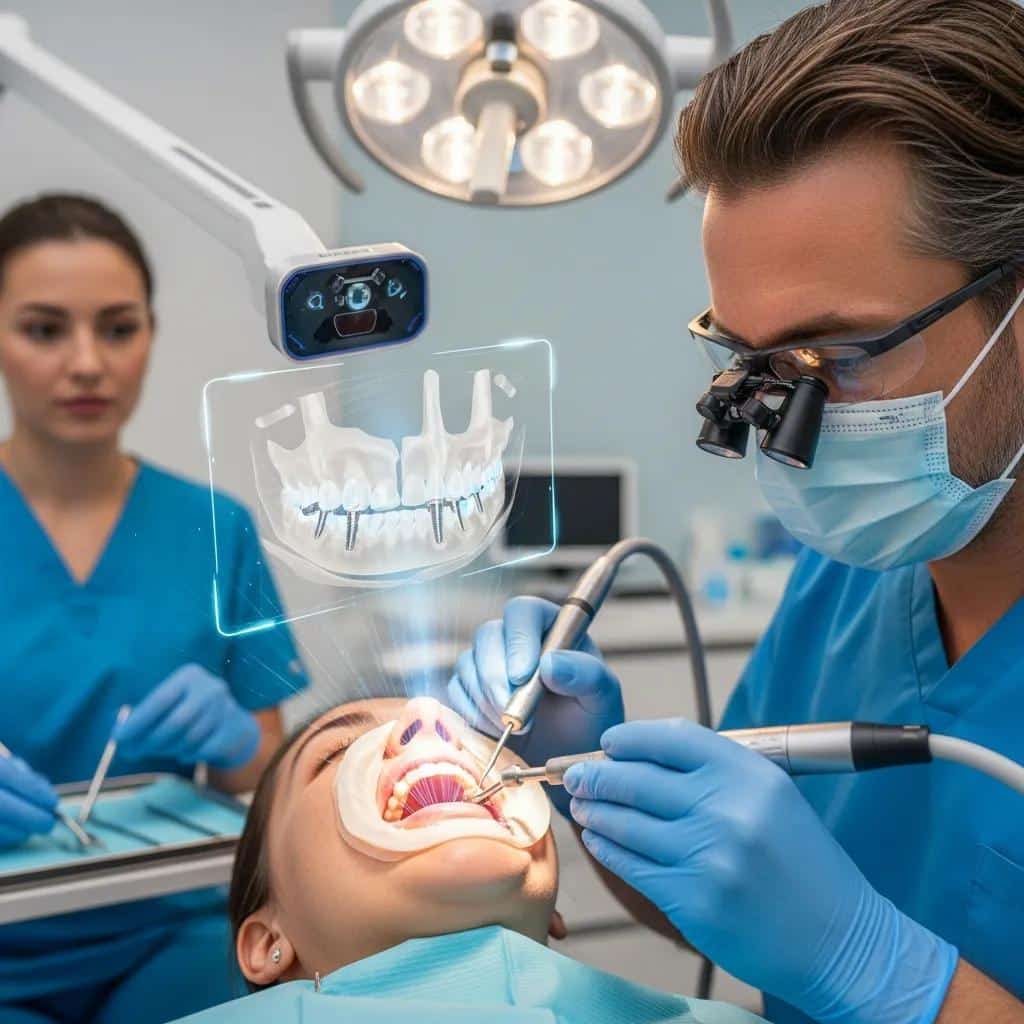
Advanced technology—such as CBCT 3D imaging, digital planning, and guided surgical systems—improves diagnostic clarity, placement accuracy, and risk reduction during implant surgery. These tools enable precise bone assessment, nerve and sinus mapping, and the creation of surgical guides that translate virtual plans into predictable physical outcomes. Understanding how these technologies change surgical workflow and patient benefits helps you prioritize clinicians who use evidence-based digital workflows for safety and long-term function.
How Does 3D Imaging Improve Implant Surgery Outcomes?
CBCT or cone beam CT provides three-dimensional visualization of bone volume, proximity to vital structures, and cortical thickness, enabling precise implant positioning and reduced intraoperative surprises. This imaging modality supports accurate measurement for graft planning and assessment of sinus anatomy, lowering the risk of nerve or sinus complications. Patients who undergo CBCT-informed planning experience fewer intraoperative adjustments and clearer discussions of alternatives, making imaging a critical component of modern implant care.
Research indicates that the type of imaging used and the surgeon’s experience can significantly influence pre-surgical planning for dental implants.
Impact of Experience and Imaging on Dental Implant Planning
There were differences in the pre-surgical planning for treatment with dental implants depending on the professional experience and the type of imaging examination used.
Influence of 2D vs 3D imaging and professional experience on dental implant treatment planning, C de Oliveira-Santos, 2019
The present review deals with imaging modalities available for preoperative planning purposes with a specific focus on the use of the cone beam CT and software for planning of oral implant surgery.
Cone Beam CT: The Future of Oral Implant Preoperative Planning
It is obvious that this hardware is not in the same class as CT machines in cost, size, weight, complexity, and radiation dose. It is thus considered to be the examination of choice when making a risk–benefit assessment. The present review deals with imaging modalities available for preoperative planning purposes with a specific focus on the use of the cone beam CT and software for planning of oral implant surgery. It is apparent that cone beam CT is the medium of the future, thus, many changes will be performed to improve these. Any adaptation of the future systems should go hand in hand with a further dose optimalization.
State-of-the-art on cone beam CT imaging for preoperative planning of implant placement, ME Guerrero, 2006
What Are the Advantages of Guided Implant Surgery?
Guided implant surgery uses a digitally planned implant position translated into the operating field via a printed or milled surgical guide, increasing placement accuracy and reducing surgical time and guesswork. Compared with freehand placement, guided workflows improve angulation and depth control, which is especially valuable in esthetic zones and when immediate temporization or multiple implants are planned. For complex full-arch cases, guided surgery improves predictability and simplifies communication between surgeon and restorative team.
The integration of digital planning and guided surgery is crucial for achieving predictable and successful implant outcomes.
Digital Planning and Guided Surgery for Predictable Implant Outcomes
Modern oral implantology and implant prosthetics depend on comprehensive diagnostics and precise planning to ensure the desired outcome and meet the patient’s and the dentist’s expectations. In this context, digital implant planning and guided implant surgery based on three-dimensional radiographic data and the digitised intraoral surfaces can be of excellent service. They provide valuable information and permit stringent backward planning to optimise the implantological and prosthetic result, improving the safety and efficiency of the surgical procedure and rendering the restorative outcome more predictable in terms of function, biology and aesthetics.
Digital implant planning and guided implant surgery–workflow and reliability, 2019
Which Implant Materials Are Commonly Used and Why?
Titanium and zirconia are the primary implant materials; titanium offers long-term track records of osseointegration and mechanical strength, while zirconia provides improved esthetics and a metal-free option for select patients. Material choice balances biocompatibility, esthetic demands, and mechanical requirements; titanium is preferred for most posterior load-bearing situations, and zirconia can be chosen for anterior esthetic zones or metal allergy concerns. Discuss material trade-offs with your surgeon to align prosthetic design, occlusal forces, and esthetic goals before committing to a specific implant system.
The following list summarizes technology benefits to consider and what they achieve.
CBCT 3D Imaging: Provides precise bone mapping to reduce surgical risk and guide planning.
Digital Planning Software: Enables virtual implant placement and prosthetic-driven decisions.
Guided Surgical Stents: Translate plans into accurate intraoperative implant placement.
Intraoral Scanning: Improves restorative fit and communication with the dental lab.
These technologies collectively improve predictability and patient experience; assessing which are used in a surgeon’s workflow gives insight into their commitment to modern, evidence-based implant care.
What Questions Should You Ask During Your Implant Surgeon Consultation?
A focused consultation checklist helps you evaluate clinical competence, process clarity, and communication style so you can compare surgeons on equal footing. Ask about experience with cases like yours, defined success and complication rates, imaging protocols, material options, sedation choices, and follow-up care obligations to ensure the proposed plan aligns with your expectations. Below are prioritized questions organized by category and a practical list to bring to your appointment so you leave armed with verifiable answers.
Which Essential Questions Help Evaluate Surgeon Expertise and Approach?
Use these core questions to probe clinical skill, planning rigor, and contingency handling: How many similar cases have you done? What is your documented success and complication rate? Which imaging and guided techniques will you use? What are the material alternatives and why do you recommend this option? How will any required grafting be performed and who handles prosthetic restoration? Clear, evidence-based answers indicate a surgeon who uses data to guide patient selection and surgical strategy.
Take this short consultation checklist to your appointment; each item helps reveal reasoning and competence.
Experience: How many implants like mine have you placed and what complications occurred?
Planning: Will you use CBCT and a digital treatment plan for my case?
Materials: Which implant and restorative materials do you recommend and why?
Contingencies: What happens if an implant fails or additional grafting is needed?
Use answers to these questions to compare providers and identify red flags such as vague timelines, evasive answers, or lack of measurable data.
How to Discuss Sedation Options and Patient Comfort?
Sedation ranges from local anesthesia to IV sedation and general anesthesia, each with different monitoring needs and safety protocols; discuss which option is recommended for your procedure and why. Ask whether an anesthesiologist or trained sedation provider will be present, what monitoring equipment is used, and what recovery protocols are in place to manage nausea or prolonged drowsiness. Understanding sedation logistics helps you plan transport and postoperative support while also ensuring the surgical team meets accepted safety standards.
What Should You Expect from a Comprehensive Implant Consultation?
A comprehensive consultation includes a medical and dental history review, thorough oral exam, CBCT imaging if indicated, presentation of treatment options with risks and benefits, cost estimate, and a clear timeline for surgery and restoration. Expect documentation of the proposed plan, informed consent discussions, and a description of follow-up visits and emergency contacts for complications. When these elements are present, you can compare plans by detail and transparency rather than only price.
How to Use Patient Reviews and Testimonials to Choose an Implant Surgeon
Patient reviews provide insight into communication, follow-up care, and satisfaction but must be weighed against objective clinical metrics and verified case evidence. Reliable review sources and careful interpretation help separate genuine patterns from outliers or marketing-selected testimonials. Combining review analysis with documented outcomes and a focused consultation produces the most balanced assessment when choosing an implant surgeon.
Where Can You Find Reliable Patient Reviews and Ratings?
Trustworthy review sources include regulated health directories, professional organization member lists, and third-party review platforms that verify reviewer identity; cross-check multiple venues for consistency. Look for reviews that include procedural details, healing timelines, and postoperative follow-up rather than only star ratings. Verify any claims by asking the surgeon for representative cases with documentation during your consultation.
What Do Positive and Negative Reviews Reveal About a Surgeon?
Positive reviews frequently highlight communication, perceived competence, and smooth recoveries, while negative reviews often point to complications, poor follow-up, or billing issues; patterns are more informative than single comments. Evaluate whether complaints relate to clinical outcomes, administrative friction, or unrealistic expectations; recurring themes such as poor follow-up care or unexplained costs deserve particular attention. Use patterns in reviews to craft specific consultation questions that probe those exact issues.
How Do Patient Testimonials Influence Your Decision-Making?
Patient stories should complement objective evidence—use testimonials to gauge bedside manner, recovery experience, and satisfaction with esthetic outcomes while prioritizing measurable clinical metrics for safety and longevity. Combine testimonials with success-rate data, specialist training, and before-and-after case documentation to make a reasoned choice rather than an emotional one. If reviews raise concerns, bring them up during consultation to hear the clinician’s perspective and corrective processes.
The following list summarizes how to weigh reviews effectively.
Look for Patterns: Repeated comments across platforms reveal systemic strengths or issues.
Prefer Detailed Accounts: Specifics about procedures and follow-up are more reliable than short praise.
Cross-Verify: Compare reviews with documented outcomes and ask for representative cases.
Using reviews this way turns anecdote into actionable insight and prepares you for targeted consultation questions.
What Are the Financial Considerations When Choosing an Implant Surgeon?
Financial planning for dental implants requires understanding itemized cost components, how complexity affects price, and what financing or warranty options may mitigate risk. Costs commonly include the implant fixture, abutment, prosthetic crown or bridge, grafting materials, imaging, sedation, and follow-up care. A clear EAV-style cost breakdown helps you compare quotes and ask the right documentation questions to avoid hidden fees and budget surprises.
How Much Do Dental Implants Typically Cost?
Implant cost varies widely by region and complexity, with per-tooth implant procedures often showing base costs for fixture, abutment, and crown plus additional charges for grafting or sinus lifts; total ranges reflect these variables. Use the table below to understand common cost components and questions to ask when comparing estimates, and request itemized quotes and documentation so you can compare proposals accurately between providers.
Cost Component
Typical Range / What It Covers
Questions to Ask / Documentation to Request
Implant fixture
Covers the surgical implant body and placement
Ask for brand, warranty, and itemized fixture cost
Abutment
Connector between implant and crown
Request type (stock vs custom) and associated fees
Crown / Prosthesis
Final prosthetic restoration costs
Ask about materials, lab fees, and expected lifespan
Bone grafting / Sinus lift
Additional surgical procedures and materials
Request graft material details and separate pricing
Sedation / Anesthesia
Monitoring and sedation provider fees
Ask who provides sedation and include monitoring costs
What Financing Options Are Available for Dental Implant Procedures?
Common financing routes include medical credit plans, dental loans, in-office payment plans, and limited insurance contributions for restorative work; each carries different interest rates, approval timelines, and coverage scopes. Ask about fees, early-payment penalties, and whether financing covers follow-up care or only the surgical phase; request written terms to avoid surprises. Comparing options side-by-side helps you select a plan that spreads cost without undermining long-term value in care quality.
How Does Aftercare Affect the Overall Investment in Dental Implants?
Aftercare—including routine hygiene visits, prosthetic maintenance, and occasional restorative adjustments—adds to lifetime costs but preserves implant longevity and reduces expensive complications. Budget for periodic check-ups, professional cleanings around implants, and potential prosthetic repairs; good maintenance lowers the likelihood of peri-implant disease and costly revisions. Discuss warranty terms, the scope of covered follow-up, and how the surgical team coordinates long-term restorative care to understand the full financial picture.
What Aftercare and Long-Term Support Should You Expect from Your Implant Surgeon?
Appropriate aftercare and long-term support combine immediate postoperative instructions, scheduled maintenance visits, and clear escalation protocols for complications to maximize implant survival and prosthetic function. Expect guidance on wound care, medication, diet, and activity in the early healing phase, plus a structured follow-up schedule that transitions to periodic maintenance and prosthetic checks. Understanding these expectations up front clarifies responsibilities between surgeon and restorative dentist and helps protect your investment.
What Are the Essential Aftercare Steps Following Implant Surgery?
Essential immediate care includes wound hygiene, prescribed antimicrobial or analgesic regimens, a soft-food diet for the initial healing phase, and instructions to avoid pressure on the surgical site; follow these to promote osseointegration and minimize infection risk. Recognize red-flag symptoms—excessive swelling, fever, uncontrolled bleeding, or implant mobility—and have a clear process for urgent contact. Proper early care sets the stage for long-term stability, which leads naturally into scheduled maintenance and check-ups.
How Does Ongoing Support Impact Implant Longevity?
Regular professional exams and hygiene maintenance reduce plaque accumulation and peri-implant inflammation, which are major drivers of late implant failure; evidence links structured follow-up to better long-term survival rates. Prosthetic maintenance—such as occlusal adjustments and replacement of worn components—also preserves function and prevents overload-related complications. A documented plan for long-term follow-up that includes both surgeon and restorative team roles improves outcomes and patient satisfaction.
When Should You Schedule Follow-Up Visits and Maintenance?
A common timeline includes an early postoperative visit within one week, a one-month check, a three-month assessment for osseointegration, a six-month prosthetic review, and then annual examinations with radiographic evaluation as indicated. Each visit should document soft-tissue health, probing depths around implants, occlusion, and prosthetic integrity to catch early issues. Adhering to this schedule allows timely intervention if complications arise and preserves both implant health and prosthetic longevity.
Aftercare steps summarized:
Immediate Care (First 1–2 weeks): Wound hygiene, medications, and soft diet to support healing.
Early Follow-Up (1 week to 3 months): Check osseointegration progress and address any complications.
Long-Term Maintenance (6 months to annual): Professional hygiene and prosthetic inspections to sustain implant health.
These steps, when followed and coordinated between surgical and restorative teams, convert a successful surgery into lasting oral function and esthetics.