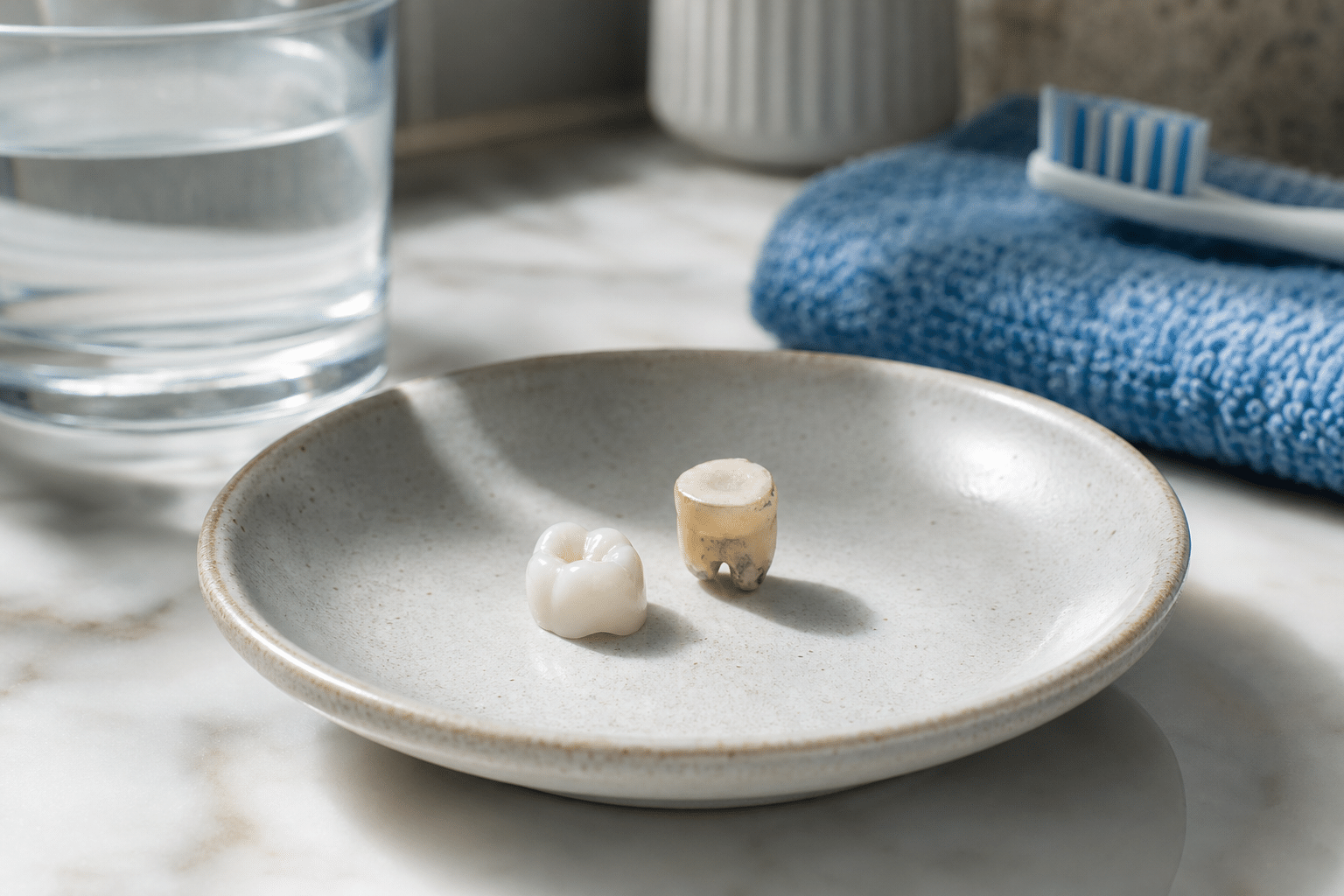
My crown fell out but it doesn't hurt, that was my first thought, and it may be yours too. Even without pain, you still need to act quickly. Retrieve the crown, clean it, and use a temporary adhesive to protect the exposed tooth. Most cases can wait a few days, but waiting more than a week risks shifting teeth, decay, and a more expensive repair.
No pain is reassuring, but it does not mean the tooth is fine on its own. The exposed tooth structure is vulnerable to bacteria, temperature, and pressure the moment the crown comes off. Acting now keeps a simple recement from turning into a root canal or a full replacement.
Why My Crown Fell Out but It Doesn’t Hurt
The most common reason a crown detaches without pain is that the tooth underneath has had a root canal. A root canal removes the nerve tissue from inside the tooth, so there is nothing left to send a pain signal when the crown loosens or falls away. You can have a fully exposed tooth stump and feel nothing at all.
Even on a tooth with a living nerve, pain may not appear right away. The crown acts as a shield, and once it comes off cleanly, the exposed dentin may not be immediately sensitive if the cement seal held long enough to reduce nerve activity over time.
Worn cement is the most frequent mechanical cause. Dental cement breaks down gradually from chewing forces, acidic foods, and moisture. According to MedlinePlus, a dental crown has a standard minimum lifespan of 5 years, with high-quality crowns lasting 15 to 20 years. (MedlinePlus article 007631.) A crown that has been in place for a decade or more has likely been working against weakening cement for some time before it finally let go.
A low-prep tooth is another factor. When the tooth structure beneath the crown is short or has little surface area, the crown has less mechanical grip. Small shifts in your bite over the years can gradually work it loose, with no sudden pain event to warn you.
Knowing why your crown came off helps you describe the situation accurately when you call the dentist. It also explains why feeling no pain is not a reason to delay: the underlying tooth is unprotected regardless of what you feel.
How to Temporarily Recement Your Crown at Home
You can protect the exposed tooth tonight with items available at most pharmacies. The goal is not a permanent fix. It is to keep the crown seated, reduce sensitivity, and prevent bacteria from settling into the exposed tooth stump before your appointment.
Follow these steps in order:
-
Retrieve the crown and store it. Pick up the crown carefully and place it in a small plastic bag or a clean container [S1]. Do not wrap it in tissue, which can stick to the interior and make cleaning harder.
-
Clean the inside of the crown. Use a toothpick or a cotton swab to gently remove old cement and any debris from the hollow interior [S2]. The crown needs to seat flush against the tooth, so any residue left inside will prevent a proper fit.
-
Rinse your mouth with warm salt water. Dissolve about half a teaspoon of salt in a cup of warm water and rinse for 30 seconds [S3]. This clears bacteria from the exposed tooth area and reduces the risk of infection while the tooth is unprotected.
-
Apply a thin layer of temporary adhesive. Temporary dental cement kits, available at most pharmacies, are the most reliable option here. These kits provide a purpose-built adhesive designed to hold a crown in place for a few days. Denture adhesive works as a milder alternative if a cement kit is not available. Apply a thin, even layer to the inside of the crown only [S4]. Per afterva.com and london.wtepharmacy.nhs.uk, using too much adhesive can prevent the crown from seating fully and throw off your bite.
-
Reseat the crown and bite down. Place the crown over the tooth stump and press firmly with your finger first to align it, then bite down gently but steadily to seat it fully [S5]. Check in a mirror that it sits flush and matches the surrounding teeth. If it feels high or off-center, remove it, clean out the excess adhesive, and try again.
-
Protect the tooth until your appointment. Avoid chewing on the affected side and stick to soft foods [S6]. Avoid chewing on the temporarily repaired side until your dentist has professionally recemented the crown.
For more guidance on what to do immediately after a crown comes off, search for an emergency dentist near you who can assess your specific situation.
Can I Use Mouthwash If My Crown Fell Out?
Avoid alcohol-based mouthwash on an exposed tooth. Alcohol can trigger sensitivity that was not present before and does nothing to help the tooth stay clean. Warm salt water is the better choice: dissolve half a teaspoon of salt in a cup of warm water and rinse two to three times a day, especially after meals.
On diet: stick to soft foods and avoid anything very hot, very cold, or sticky. Sticky foods like caramel or chewing gum can pull a temporarily seated crown right back off. Chew on the opposite side of your mouth as much as possible until the crown is professionally recemented.
My Crown Fell Off, How Long Can I Wait Before Seeing a Dentist?
For most people, a few days is a reasonable window. If the crown came off cleanly, the tooth has no pain, and you have reseated the crown with a temporary adhesive, you can usually schedule a regular appointment rather than rushing to an emergency visit. The outer limit, though, is about one week.
NHS England guidelines cited by Decay Guide in 2026 state that a displaced crown requires clinical assessment within seven days for cases without airway risks. That is a general outer limit, not a green light to wait the full seven days in every situation. Your specific circumstances matter.
Why waiting too long causes real problems. The exposed tooth stump is softer and more porous than the crown surface that was protecting it. Bacteria settle into that exposed structure quickly, and decay can begin within days. The longer the crown stays off, the more likely you are to need more than a simple recement when you finally see a dentist.
Adjacent teeth and the opposing tooth also shift when a crown is missing. Teeth drift toward open spaces, even small ones. A crown that fit perfectly on Monday may not seat correctly by the following week if the surrounding teeth have moved even slightly, turning a straightforward recement into a new crown.
Signs that mean you should not wait at all. Call for a same-day or next-day appointment if you notice any of the following:
- Pain or throbbing that starts after the crown comes off
- Visible black or dark discoloration on the exposed tooth
- Swelling in the gum around the tooth
- You swallowed the crown and are having any difficulty breathing or swallowing
- The crown came off with a piece of tooth attached
If your dentist is unavailable, look for a same-day emergency dental appointment rather than waiting for a regular opening. These situations can worsen quickly and are worth treating as urgent.
For everyone else, book within two to three days. That window keeps the tooth protected, gives the temporary adhesive enough time to hold, and avoids the complications that come with a longer delay.
Special Situations: Black Tooth, Swallowed Crown, or Tooth Fragment
Some crown situations go beyond a standard recement. Three scenarios call for faster action or a different approach entirely.
My crown fell off and my tooth is black.
Dark or black discoloration on the exposed tooth stump is not a cosmetic issue. It usually signals one of two things: old metal from a previous filling or post has stained the dentin over time, or there is active decay or dead pulp tissue inside the tooth. Staining alone is not an emergency, but decay or a dying nerve is. You cannot tell the difference by looking. A dentist needs to take an X-ray to assess what is happening beneath the surface. Do not recement the crown yourself and wait if the tooth looks black. Book an appointment within one to two days, sooner if you feel any pain or swelling.
My crown came off with part of the tooth.
If you look at the crown and see a fragment of natural tooth structure attached to the inside, or if the tooth stump feels jagged or shorter than it should, the underlying tooth has fractured. This changes the treatment picture significantly. A fractured tooth may not support a new crown without additional work, such as a buildup or a post. In some cases, the tooth cannot be saved and extraction becomes the only option. Do not attempt to recement a crown in this situation. Store the crown and the fragment together in a bag and call your dentist the same day.
My crown fell out and I swallowed it.
Swallowing a crown is more common than most people expect, and in the vast majority of cases it passes through the digestive system without causing harm. The concern is if the crown was inhaled rather than swallowed. If you feel any chest tightness, difficulty breathing, or persistent coughing immediately after the crown went missing, go to an emergency room right away. That is a medical emergency, not a dental one. If you are confident you swallowed it and have no respiratory symptoms, call your dentist to discuss whether the crown can be replaced or if a new one is needed. You will not be able to retrieve and reuse it.
How Much Does It Cost to Recement a Crown That Fell Off?
No standard public price exists for recementing a crown. The cost varies based on several factors, and what you pay depends on your specific situation.
The condition of the crown matters most. If the crown is intact, clean, and still fits the tooth properly, recementing it is a straightforward procedure that takes one short appointment. If the crown is cracked, worn, or no longer fits because the tooth has changed, you may need a new crown entirely, which is a very different cost.
The condition of the tooth underneath also affects the price. If decay has developed on the exposed tooth stump while the crown was off, the dentist needs to remove that decay and possibly place a buildup before recementation. That adds time and cost to the visit.
Always ask for a written estimate before agreeing to any treatment. A reputable dental office will examine the crown and the tooth, take an X-ray if needed, and tell you exactly what is required and what it will cost before doing any work. If you need a full replacement crown rather than a simple recement, ask whether your dental insurance covers any portion, and ask about financing options if the out-of-pocket cost is a concern.
For a full picture of what crown work typically involves financially, ask your dental office for a written estimate that itemizes each step before you agree to any treatment.
What to Do If Your Crown Falls Off and the Dentist Is Closed
Most crown situations are not true medical emergencies, but losing a crown after hours can feel urgent, especially if the tooth is sensitive or you have no temporary adhesive on hand. The six-step home fix described earlier works just as well at 10 PM as it does during office hours. Get the crown cleaned, apply a temporary dental cement kit or denture adhesive, reseat the crown, and protect it with soft foods until you can reach a dentist.
If you cannot find a temporary cement kit, a small amount of denture adhesive from a pharmacy will hold the crown in place overnight. Do not use super glue or any household adhesive. They are not safe for oral use and can permanently damage both the crown and the tooth stump.
When home care is not enough. Some situations cannot wait for a Monday morning appointment. If you have pain, visible swelling, a black tooth, a fractured tooth stump, or any respiratory symptoms after swallowing the crown, you need same-day care. In those cases, skip the home fix and go straight to an urgent dental provider or, for breathing difficulty, an emergency room.
Finding same-day dental care on a weekend or holiday. Many dental groups now hold Saturday hours or same-day slots specifically for situations like this. Search for a dental office that lists emergency or same-day availability before defaulting to a hospital urgent care, which typically cannot handle dental restorations.
Search online for dental offices in your area that list same-day or emergency availability. Many practices hold weekend hours specifically for situations like this, and booking one of those slots is faster than waiting for a hospital urgent care that cannot handle dental restorations.
If the dentist is closed and your tooth is stable with the temporary fix in place, book the first available appointment for the next business day. A closed office is not a reason to wait a full week.
Prices and plan limits verified as of October 2026.
FAQs
Can a crown be permanently recemented after falling out, or will I need a new one?
It depends on the condition of both the crown and the tooth underneath. If the crown is structurally intact, fits the tooth correctly, and the tooth stump has no new decay, a dentist can often recement the original crown in a single short visit. If the crown is cracked, the fit has changed, or decay has developed on the exposed tooth, a new crown is likely needed. An X-ray at your appointment will clarify which situation applies to you.
Is it normal for a crown to fall off more than once?
Repeated detachment usually points to a mechanical issue rather than a one-time failure. It often means the tooth stump is short or has limited surface area, the crown no longer fits precisely, or the underlying tooth has changed shape due to new decay or a fracture. If your crown has come off more than once, ask your dentist to assess whether the current crown can be reused or whether a new one with a better fit would hold more reliably.
Can I eat normally with a temporary adhesive holding my crown?
No. Temporary adhesive is not strong enough to handle normal chewing forces. Stick to soft foods such as yogurt, mashed potatoes, eggs, and soup. Avoid anything sticky, crunchy, or hard, and chew on the opposite side of your mouth as much as possible. Eating on the temporarily repaired side risks dislodging the crown again, and a second detachment may damage the tooth stump or make the crown harder to reseat.
Will my insurance cover recementing a crown that fell off?
Coverage depends on your specific plan, how recently the crown was placed, and whether the crown needs replacement rather than just recementation. Some plans have a waiting period before covering crown-related work again. Call your insurance provider before your appointment to confirm what is covered, and ask the dental office to verify your benefits when you book.
What happens to the tooth underneath if I leave the crown off for too long?
Without the crown, the exposed tooth stump is vulnerable to bacteria, temperature, and physical stress. Decay can begin within days on unprotected dentin. Adjacent and opposing teeth start to shift toward the open space, which can prevent the original crown from fitting correctly when you do return. In some cases, a tooth left unprotected for several weeks develops enough decay or fracture that it can no longer support a crown at all, turning a simple recement into a much more involved and costly procedure.
Conclusion
A crown that falls out without pain is not an excuse to delay, but it is not a reason to panic either. The tooth is exposed and vulnerable, and the clock starts the moment the crown comes off. A temporary adhesive buys you a few days of protection, but professional recementation within two to three days is the right target for most people.
Retrieve the crown, use a temporary cement kit or denture adhesive to reseat it tonight, and call a dentist first thing in the morning to book the earliest available appointment. If you notice pain, swelling, or dark discoloration before then, treat it as urgent and look for a same-day opening. The sooner the crown is professionally secured, the less likely you are to need anything beyond a simple recement.