Best overall for speed: in-office teeth whitening. Best for supervised home treatment: dentist-made trays. Best for a ready-to-use home routine: whitening strips. This 2026 guide ranks the fastest teeth whitening options by treatment setting, effort, and limitations; Affordable Dentist Near Me provides teeth whitening alongside general, cosmetic, and restorative dental care.
TL;DR
In-office bleaching is the fastest teeth whitening option for suitable natural teeth, but results vary by stain type.
Dentist-made trays provide supervised at-home whitening; whitening strips require consistent use according to their label.
Whitening toothpaste removes surface stains rather than matching the bleaching effect of peroxide treatments.
Affordable Dentist Near Me serves Texas families seeking teeth whitening alongside general dental care.
Fastest teeth whitening options at a glance
Rank and option
Best for
Standout feature
Speed expectation
Key limitation
1. In-office bleaching
The shortest treatment course
Dentist-applied bleaching with gum protection
Visible change is possible during one visit
Sensitivity and stain type affect suitability
2. Dentist-made whitening trays
Supervised treatment at home
Trays fitted to your teeth
Repeated applications rather than an instant result
Requires fitting and consistent use
3. Whitening strips
A ready-to-use home routine
Pre-applied bleaching gel
Follow the product's full treatment course
Coverage and results depend on fit and formula
4. Whitening toothpaste
Managing surface stains
Stain removal during brushing
Gradual surface-stain improvement
Does not bleach deeper tooth color
The lower positions are not universal speed differences. Dentist-made trays and whitening strips have different formulas and schedules, so neither always finishes first. In-office bleaching takes the top position because treatment happens under direct dental supervision rather than through repeated home applications.
Why this matters
A brighter smile by an event date is a different goal from removing years of discoloration. Before choosing a treatment in 2026, separate the time spent applying it from the time needed to reach a suitable result.
Bleaching changes the color of natural teeth. It does not whiten crowns, veneers, or tooth-colored fillings, and it does not correct every cause of discoloration. An examination helps you avoid spending time on a treatment that cannot address your concern.
What makes the best fast teeth whitening option?
Judge speed alongside these criteria, not in isolation:
Time to visible change: Does treatment aim for a change during an office visit or through repeated home use?
Stain suitability: Surface staining, age-related yellowing, and a single dark tooth need different assessments.
Sensitivity management: Existing pain or gum irritation changes the treatment decision.
Coverage: Gel must reach the natural tooth surfaces you want to lighten without unnecessary gum contact.
Treatment control: Professional supervision and clear instructions matter more than the strongest-sounding label.
Follow-through: A home method only works as intended when you follow its prescribed or labeled schedule.
American Dental Association patient guidance distinguishes peroxide bleaching from products that mainly remove surface stains. That distinction drives this ranking: a toothpaste and an office bleaching treatment do not perform the same job.
1. In-office bleaching: best teeth whitening for speed
In-office bleaching uses a whitening agent applied by a dental professional, with protection for your gums. It concentrates treatment into an appointment instead of asking you to complete a home course first.
The American Dental Association's MouthHealthy guidance describes an office bleaching visit as usually taking 30–60 minutes. That is a general treatment reference, not a promised appointment length or result at Affordable Dentist Near Me; an examination and other care add separate steps.
In-office bleaching pros:
Treatment takes place under direct dental supervision.
Gum protection limits contact with the bleaching agent.
You do not have to position strips or manage trays during treatment.
A visible change is possible within the treatment visit.
In-office bleaching cons:
Temporary tooth sensitivity or gum irritation can occur.
Some discoloration does not respond well to bleaching.
A single visit does not guarantee your preferred final shade.
Best for: Adults with suitable natural teeth who prioritize the shortest treatment course.
For a 2026 event deadline, ask whether your teeth need other care before bleaching and when to assess the result. Do not assume that adding a light or a laser automatically makes a treatment faster or more effective; ask what the treatment itself involves.
Verdict: Buy only after a dental assessment confirms that bleaching fits your teeth and deadline.
2. Dentist-made trays: best teeth whitening for supervised home use
Dentist-made trays hold whitening gel against your teeth during home treatment. The dentist provides instructions for the specific gel and tray system rather than leaving you to select a wear time yourself.
This option trades an immediate office treatment for repeated applications. It ranks second for professional oversight and fit, not because every custom-tray treatment is faster than every whitening strip.
Dentist-made tray pros:
Trays are fitted to your teeth.
You receive instructions for the prescribed whitening agent.
You can report sensitivity and ask the dentist about adjustments.
Treatment happens at home after the required dental steps.
Dentist-made tray cons:
Fitting and repeated use add steps before the final result.
Too much gel or incorrect wear can irritate gums.
Missed applications make the treatment less predictable.
Best for: People who want dental supervision but prefer applying whitening treatment at home.
Ask how much gel to use, how long to wear the trays, and what to do if your teeth become sensitive. Never borrow another person's tray instructions: different whitening agents require different use.
Verdict: Buy if you can follow a dentist-directed course and do not need an immediate result.
3. Whitening strips: best teeth whitening for a ready-to-use routine
Whitening strips place a thin layer of bleaching gel against your teeth. They do not require custom fitting, but their placement, coverage, and treatment schedule depend on the product.
Choose instructions you can follow consistently. A shorter application time does not, by itself, prove a shorter overall course or a better result.
Whitening strip pros:
Pre-applied gel reduces the need to measure treatment material.
No custom tray fitting is required.
Labeled instructions define application and treatment limits.
Whitening strip cons:
Strip shape does not fit every smile equally well.
Gum contact can cause irritation.
Crowded or uneven teeth can make placement difficult.
Best for: Adults seeking a straightforward home bleaching method after confirming that whitening is appropriate.
For your 2026 comparison, read the complete label rather than judging the package's fastest-sounding claim. If a product carries the American Dental Association Seal of Acceptance, that identifies an evaluated product; it does not promise a particular shade change for your teeth.
Verdict: Buy for a label-directed home course, not as a substitute for assessing unexplained discoloration.
4. Whitening toothpaste: best for surface-stain maintenance
Whitening toothpaste mainly helps remove surface stains through its cleaning ingredients. It is not equivalent to peroxide bleaching that changes the color within natural teeth.
That makes toothpaste a maintenance choice, not the default answer to fastest teeth whitening. Removing a surface stain can improve appearance without changing the tooth's underlying shade.
Whitening toothpaste pros:
Fits into your existing brushing routine.
Helps manage surface stains.
Fluoride-containing options also support cavity prevention.
Whitening toothpaste cons:
Does not match bleaching for deeper color change.
Brushing harder does not improve whitening safely.
Persistent discoloration still needs assessment.
Best for: People focused on surface stains rather than a substantial shade change.
The American Dental Association recommends brushing for 2 minutes, twice a day, with fluoride toothpaste. Keep that routine; do not add force or extra brushing sessions to chase a faster cosmetic result.
Verdict: Buy for routine stain management; skip it as your main plan for a rapid shade change.
Match the method to the stain before your deadline
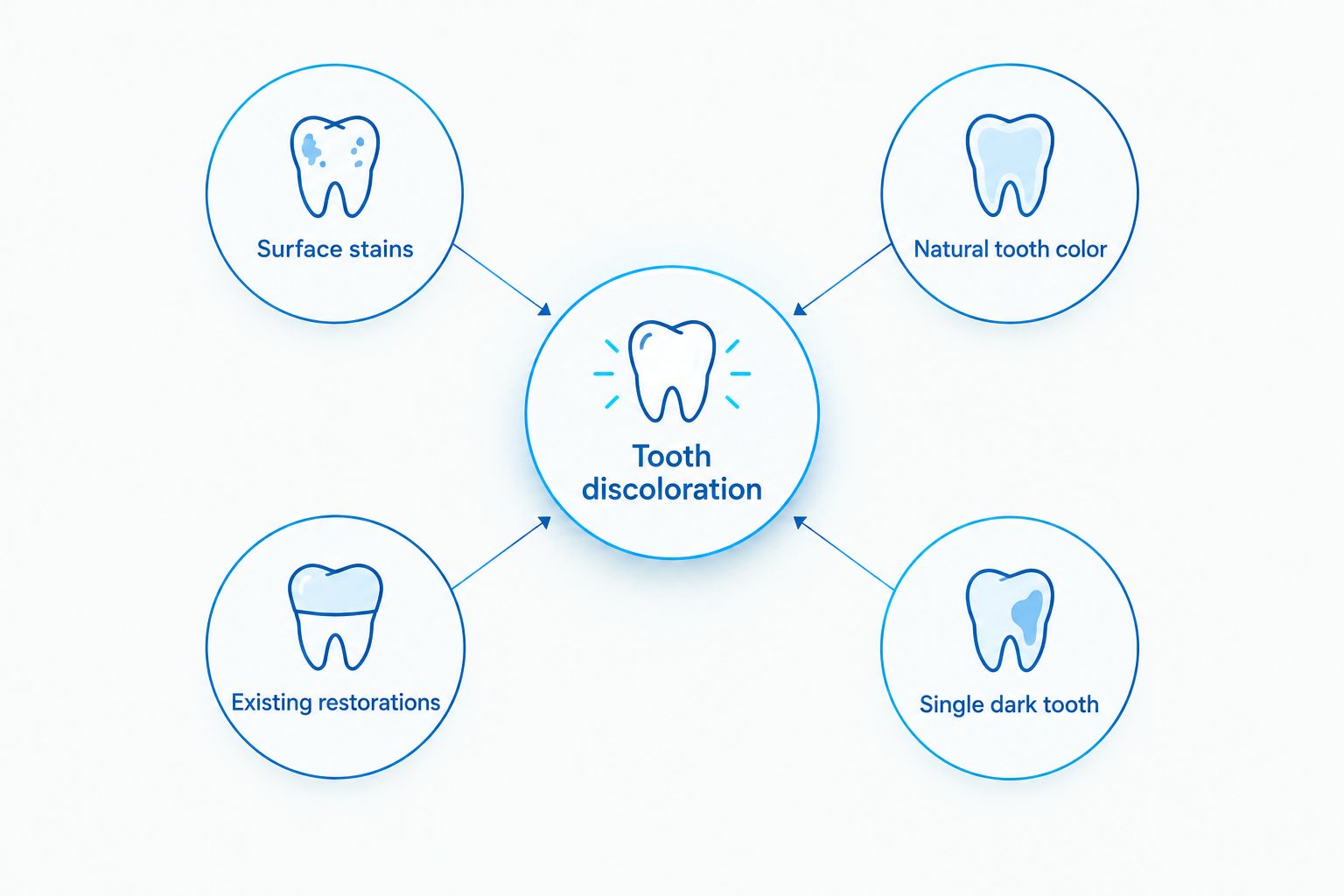
The fastest suitable route starts with identifying what looks dark. Tell the dentist whether the color affects your whole smile, follows the gumline, or appears in a single tooth.
Surface stains: Cleaning or stain-removal products address deposits on the outside of teeth.
Natural tooth color: Bleaching targets discoloration within suitable natural teeth.
Existing restorations: Crowns, veneers, and fillings do not lighten with tooth bleaching.
Single dark tooth: A dental examination should establish the cause before cosmetic treatment.
Identify the cause of discoloration before choosing a whitening method.
A cleaning and bleaching serve different purposes. Cleaning removes plaque, hardened deposits, and certain surface stains; bleaching changes tooth color. If deposits are the main problem, choosing stronger bleach does not replace the care you need.
For mixed natural teeth and restorations, discuss the overall color match first. Whitening only the natural teeth can make an existing crown or filling look more noticeable.
Sensitivity changes the fastest safe route
A shorter course is not a better choice if pain forces you to stop. Explain any existing sensitive teeth, including whether cold drinks, brushing, or biting triggers the discomfort, before selecting a bleaching method.
Mention where the pain occurs and whether it lingers after the trigger stops. Those details help a dentist distinguish a whitening concern from a problem that needs treatment first.
Do not stack strips, tray gel, and other bleaching products to accelerate the result. Follow one professionally directed or labeled course, and stop using the product if irritation develops until you receive appropriate advice.
Sensitivity checklist:
Tell the dentist about existing pain before bleaching.
Mention exposed roots, gum problems, and previous whitening reactions.
Ask what symptoms mean you should pause treatment.
Seek dental assessment for persistent, severe, or localized pain.
For a 2026 whitening plan, comfort belongs in the schedule from the start. A plan you can complete safely is more useful than an aggressive course you abandon.
How to plan around an event
Work backward from the event without promising yourself a particular shade. Ask the dentist which parts of the process are necessary for your mouth, then make the treatment decision.
Start with the examination
Tell the office your event date and cosmetic goal. An examination can identify decay, gum inflammation, or restorations that affect the plan; whitening should not take priority over treating disease.
Confirm the complete course
Ask about the treatment visit, home applications, follow-up, and what happens if sensitivity develops. Count the whole process, not just the minutes a whitening agent touches your teeth.
Keep the routine simple
Use only the instructed amount and wear time. More gel, longer contact, and overlapping products are not reliable shortcuts and increase the risk of irritation.
Assess a realistic result
Ask when to judge the shade and whether further treatment is appropriate. Teeth do not all respond identically, so a package photograph is not a dependable personal target.
Affordable Dentist Near Me serves families in Fort Worth, Dallas, Houston, Waco, Grand Prairie, and Crowley. Contact the office for more information about teeth whitening and which next step fits your dental needs.
Discuss your whitening goal
Ask about whitening suitability, sensitivity, and the steps needed before treatment.
This 2026 ranking prioritizes the shortest professionally supervised route, then home-treatment control, placement, and stain-removal limits. It does not assign invented shade improvements or treat every whitening formula as interchangeable.
In-office bleaching wins on concentrated treatment. Dentist-made trays win on fitted, supervised home use; strips suit a ready-to-use routine. Toothpaste belongs last for speed because surface-stain removal is not the same task as bleaching.
Which teeth whitening option should you choose?
Choose in-office bleaching when speed is your priority and a dentist confirms you are a suitable candidate. Choose dentist-made trays when supervised home treatment fits your routine better, or strips when a suitable label-directed course meets your needs.
Affordable Dentist Near Me is a teeth whitening option for Texas families seeking cosmetic care alongside general dental services. Ask for an assessment rather than a guaranteed shade: the cause of the discoloration determines what treatment can accomplish.
FAQ
What’s the fastest teeth whitening option?
In-office bleaching is the fastest option for suitable natural teeth because treatment takes place during a dental visit. Stain type, tooth health, and your desired result determine whether further treatment is needed.
Can I whiten my teeth in one day?
A visible change is possible with in-office bleaching during one visit, but a specific shade is not guaranteed. Ask a dentist whether your discoloration is likely to respond.
Are dentist-made trays faster than whitening strips?
Dentist-made trays are not always faster than whitening strips. The whitening agent, instructions, tooth condition, and consistency of use determine the course.
Does an LED light make teeth whitening faster?
A light alone does not establish that a whitening treatment is faster or more effective. Ask about the bleaching agent, treatment instructions, and evidence for the complete system.
What’s the fastest whitening choice for sensitive teeth?
The first step for sensitive teeth is a dental assessment, not a stronger whitening product. The dentist can identify the cause and discuss whether bleaching is appropriate.
Will whitening change the color of my crowns or fillings?
Bleaching does not whiten crowns, veneers, or tooth-colored fillings. Discuss the color match before whitening nearby natural teeth.
Can whitening toothpaste give me the same result as office bleaching?
Whitening toothpaste does not provide the same type of color change as office bleaching. It mainly removes surface stains rather than bleaching deeper tooth color.
One last thing
Whiten before choosing the final shade of a planned visible restoration, if your dentist recommends whitening. Because a crown or filling will not bleach afterward, the order of cosmetic treatment matters as much as its speed.
Do not replace sound dental work just to chase a whiter smile without discussing the alternatives. Start with the least invasive treatment that addresses your actual concern.