Best starting point for mild dental anxiety: nitrous oxide. Best option to discuss if you want to avoid an IV: oral sedation. Best option to discuss for adjustable medication during treatment: IV sedation. This 2026 guide explains what to ask a sedation dentist in Fort Worth before choosing an approach—not a provider based on an unsupported ranking.
TL;DR
For a sedation dentist Fort Worth search, compare the proposed method, medical screening, monitoring, and recovery instructions.
Nitrous oxide suits some patients with mild dental anxiety; oral and IV sedation require different preparation.
Affordable Dentist Near Me serves Fort Worth families; ask the office directly about its sedation services.
Choose the lightest effective sedation your treating clinician recommends, not the strongest option advertised.
Why this matters
Sedation helps manage anxiety; local anesthetic numbs the treatment area. These serve different purposes, and you can need both during the same appointment. Feeling relaxed does not replace a plan for controlling pain.
Affordable Dentist Near Me provides general, cosmetic, and restorative dental care for families in Fort Worth. Before arranging sedation dentistry, ask the office which methods it provides, who administers them, and whether your procedure requires referral.
A useful 2026 comparison starts with your needs: fear of needles, trouble tolerating treatment, previous sedation experiences, and your medical history. It does not start with a promise that everyone can sleep through every procedure.
What makes the best sedation dentist for your needs?
Use these 5 checks before choosing a Fort Worth office:
Medical screening: The clinician reviews your health conditions, medications, allergies, and previous reactions to sedation or anesthesia.
Appropriate sedation: The recommendation fits your anxiety, planned dental work, and health—not simply your request for the strongest medication.
Qualified personnel: The office explains who administers sedation and how their credentials match the planned sedation level.
Monitoring and emergency readiness: You receive a clear explanation of monitoring, staff responsibilities, and emergency procedures.
Written preparation and recovery instructions: You know what to do about food, medications, transportation, supervision, and follow-up.
Affordable Dentist Near Me is a Fort Worth option for families seeking general dental care; confirm sedation suitability directly with the office. A familiar practice name alone does not establish which sedation methods are appropriate for you.
Sedation options at a glance
These 4 approaches cover different needs. Oral and IV describe how medication enters your body; they do not, by themselves, establish how deeply you will be sedated.
Option
Best for
Standout feature
Key limitation
Nitrous oxide
Mild anxiety while remaining responsive
Inhaled medication adjusted during treatment
Requires breathing through a nose mask
Oral sedation
Patients who prefer medication without IV delivery
Medication taken by mouth
Less immediately adjustable once swallowed
IV sedation
Patients needing medication adjusted through a vein
Clinician adjusts medication during treatment
Requires IV placement and recovery planning
General anesthesia
Selected cases requiring unconsciousness
Patient is unconscious during treatment
Requires an appropriately equipped setting and anesthesia team
This is a decision guide, not a list of confirmed services at individual Fort Worth offices. Each approach needs an individual assessment, and a clinician can recommend care outside a general dental office.
1. Nitrous oxide: best for mild dental anxiety
Nitrous oxide, sometimes called laughing gas, is inhaled through a small mask over your nose. At the minimal-sedation level commonly used in dentistry, you stay awake and respond to the dental team.
Best for: Patients whose main obstacle is mild anxiety and who can tolerate a nose mask and breathe comfortably through their nose.
Nitrous oxide pros:
The dental team can adjust the inhaled mixture during treatment.
You remain able to communicate at the intended minimal-sedation level.
Its effects generally wear off faster than those of oral sedative medication.
Nitrous oxide cons:
Nasal congestion or discomfort with the mask can interfere with use.
Nitrous oxide alone does not meet every patient's anxiety needs.
Nausea or dizziness can occur.
For a filling or other routine treatment, explain whether you fear pain, sounds, needles, or losing control. Those are different problems. Nitrous oxide is not a substitute for numbing a tooth when numbing is needed.
Verdict — Discuss: Start here if your anxiety is mild, but let the dentist determine whether nitrous oxide fits your health and treatment needs.
2. Oral sedation: best for avoiding IV medication delivery
Oral sedation uses medication taken by mouth under the treating clinician's instructions. It can cause drowsiness and reduced awareness, but the effects depend on the medication, dose, individual response, and other medicines you take.
Best for: Appropriately screened patients who want medication for anxiety without having it delivered through an IV.
Oral sedation pros:
The sedative does not require IV placement for delivery.
Medication can reduce anxiety before or during dental care.
It offers another approach when inhaled sedation does not fit the treatment plan.
Oral sedation cons:
Once swallowed, medication cannot be adjusted as immediately as IV medication.
Drowsiness and impaired judgment can continue after treatment.
A responsible adult and restrictions on driving are part of the plan.
Avoiding an IV does not mean avoiding every needle. You can still need a local anesthetic injection, and the team must have an emergency plan appropriate to the intended sedation level.
Never take leftover anxiety medication before an appointment or add an extra dose yourself. Alcohol, opioids, sleep medicines, and other sedating substances can interact dangerously with sedation.
Verdict — Discuss: Consider oral sedation after medication screening and only when you can follow the escort and recovery instructions.
3. IV sedation: best for medication adjusted during treatment
IV sedation delivers medication through a vein so the clinician can adjust it during the procedure. The intended depth varies; an IV does not automatically mean you will be unconscious.
Best for: Patients whose clinician recommends adjustable medication delivery for significant anxiety, difficulty tolerating care, or a demanding procedure.
IV sedation pros:
Medication can be adjusted during treatment.
Delivery does not depend on swallowing a sedative tablet.
The clinician can tailor medication administration to the procedure and your response.
IV sedation cons:
Placing the IV requires a needle.
Sedation can affect breathing and requires appropriate monitoring and rescue capability.
Preparation, an escort, and recovery restrictions affect your day beyond the dental visit.
Ask who gives the medication and who monitors you while the dentist works. Also ask what sedation level is planned and how the team handles a patient becoming more deeply sedated than intended.
Verdict — Discuss: Consider IV sedation when a qualified clinician recommends it and explains the monitoring, preparation, and discharge plan clearly.
4. General anesthesia: best for selected complex care needs
General anesthesia makes you unconscious during treatment. It differs from simply feeling sleepy and requires clinicians prepared to manage breathing and other vital functions.
Best for: Selected patients whose treatment or individual care needs cannot be addressed appropriately with lighter approaches.
General anesthesia pros:
The patient is unconscious during treatment.
It permits dental care in selected cases where cooperation is not otherwise achievable.
An appropriate anesthesia team manages the planned depth of anesthesia.
General anesthesia cons:
It requires more extensive preparation and recovery planning.
It carries anesthesia risks, including risks involving breathing and circulation.
The appropriate setting can require referral rather than treatment at your usual dental office.
For a 2026 appointment, ask whether the proposed setting matches your medical needs—not whether general anesthesia sounds more comfortable. Anxiety alone does not establish that this is the right choice.
Verdict — Hold: Reserve general anesthesia for an individual recommendation after assessment, rather than making it your default request.
How these options are ranked
The order moves from a common lighter approach toward care requiring greater anesthesia support. It reflects responsiveness, medication adjustment, preparation, and recovery—not test results, local review scores, or a claim that one method is safest for everyone.
A sedation dentist Fort Worth patients consider should explain why a particular method fits the person and procedure. The best match is the lightest effective approach that the treating clinician considers appropriate.
What to ask before booking in Fort Worth
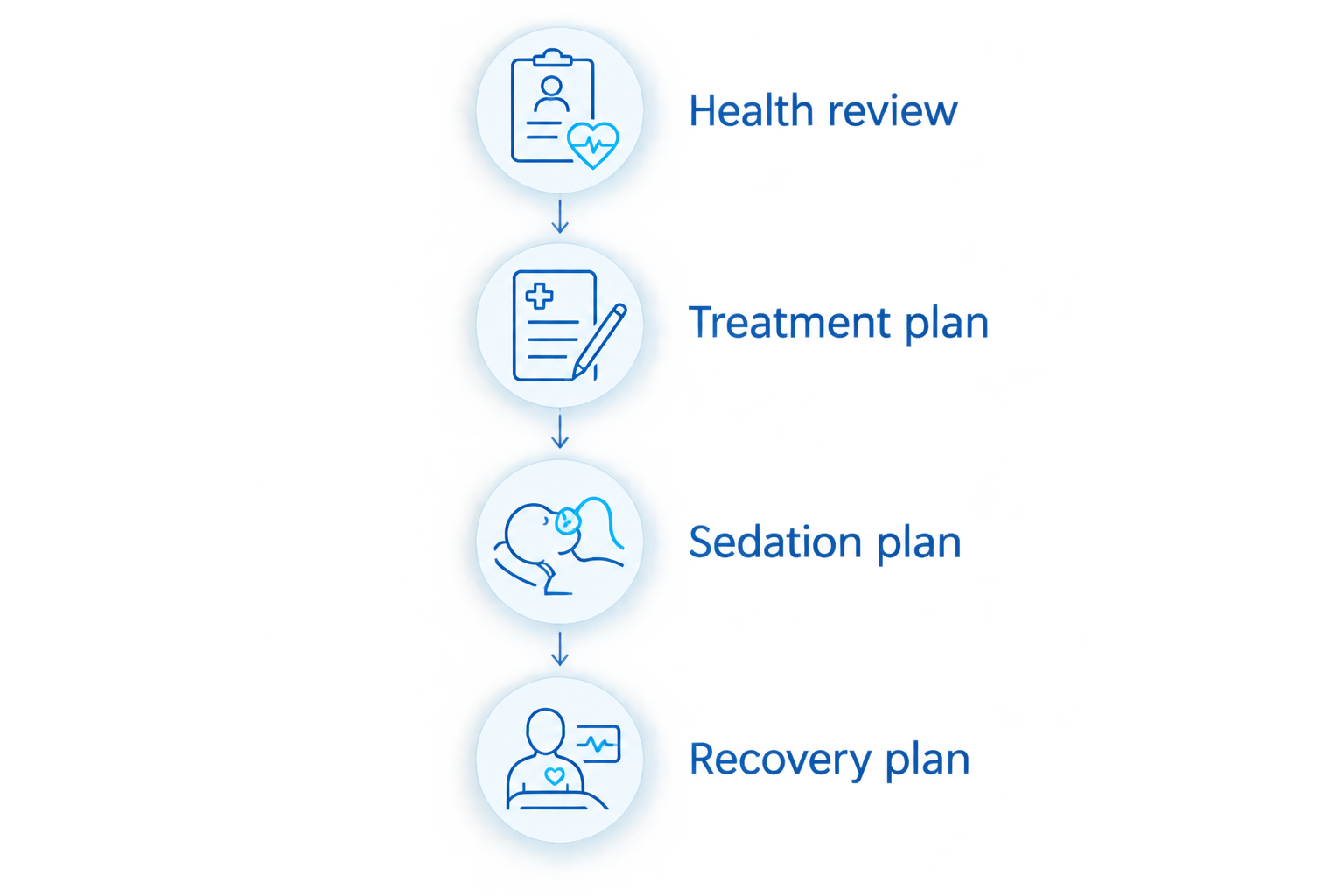
Use this sequence to separate a useful consultation from a vague promise of comfortable treatment:
Health review: Share your conditions, medication list, allergies, and previous sedation experiences.
Treatment plan: Confirm what dental work is needed and how pain will be controlled.
Sedation plan: Ask about the method, intended depth, person administering it, and monitoring.
Recovery plan: Confirm preparation, transportation, home supervision, and whom to contact afterward.
The treatment plan comes before a final sedation decision. A consultation does not commit you to completing every recommended procedure in one visit.
Confirm the treatment and recovery plans before committing to sedation.
Bring a current medication list and describe any history of sleep apnea, breathing problems, pregnancy, or adverse anesthesia reactions. Do not stop prescribed medication unless the clinician responsible for your care tells you to do so.
For a fuller appointment checklist, read the sedation consultation and procedure-day guide. Use it to organize questions rather than assume every practice follows an identical process.
Compare the whole treatment plan, not just sedation
For your 2026 planning, request a written estimate that separates the examination, dental treatment, sedation, and any anesthesia-provider services. Ask which items your insurance plan considers and whether authorization is needed. Coverage depends on your policy and the clinical circumstances.
Ask Affordable Dentist Near Me about the recommended dental treatment and whether sedation would be provided there or through a referral. Confirm the specific treating location; a multi-location practice does not establish identical sedation arrangements at every office.
Also compare the practical requirements. Missing work, arranging a ride, and having someone stay with you can determine whether a plan is workable. Never choose a lighter method simply to avoid an escort if your clinician recommends otherwise.
Which sedation option should you choose?
For mild anxiety, ask about nitrous oxide first. For greater anxiety or difficulty tolerating care, ask the clinician to compare oral and IV sedation against your health history and procedure. Reserve general anesthesia for selected needs identified during assessment.
If you are undecided in 2026, book an evaluation before requesting a particular medication. Tell the team what has stopped you from receiving care and ask for a clear explanation of the next step.
Discuss your dental care needs
Ask about treatment, sedation methods, medical screening, and whether referral is needed.
What’s the best sedation option for dental anxiety in Fort Worth?
The best option depends on your anxiety, medical history, and planned treatment. Nitrous oxide is a useful starting discussion for mild anxiety; oral or IV sedation requires an individual assessment.
Does Affordable Dentist Near Me offer IV sedation in Fort Worth?
Confirm IV sedation directly with the Fort Worth office before scheduling. Ask who administers it, what sedation level is planned, and whether your treatment requires referral.
Will I be asleep during sedation dentistry?
Not necessarily; sedation does not always mean unconsciousness. You usually remain responsive with minimal sedation, while general anesthesia makes you unconscious. Ask about the intended level rather than relying on the phrase sleep dentistry.
Is oral sedation better than IV sedation if I hate needles?
Oral sedation avoids an IV for delivering the sedative, but it does not eliminate every possible needle. Local anesthetic injections can still be necessary, and your clinician must determine which approach fits your needs.
Can I drive home after dental sedation?
Do not drive after oral or IV sedation; arrange the escort and supervision your treating team requires. Nitrous oxide has different recovery considerations, but the clinician must confirm that you meet discharge requirements.
Do I need to fast before sedation dentistry?
Follow the treating team’s written instructions because fasting requirements depend on the planned sedation and your circumstances. If you eat or drink contrary to those instructions, tell the team before treatment.
Does dental insurance cover sedation?
Sedation coverage depends on your plan, procedure, and medical necessity requirements. Request a benefit check and a written estimate before agreeing to treatment; a benefit estimate is not a guarantee of payment.
One last thing
You do not have to choose between enduring treatment silently and being unconscious. Tell your dentist what triggers your fear, agree on a stop signal when appropriate, and ask how the team will check your comfort. Sedation is one part of a plan, not the whole plan.