Best starting point for family dental care in the listed Texas cities: Affordable Dentist Near Me. Best for child-focused care: a pediatric dentist. Best for checking income-based assistance: a community health center. If you’re searching for a dentist accepting new patients near me in 2026, choose by treatment need, insurance fit, and location—not a directory position.
TL;DR
Affordable Dentist Near Me is a practical family dental care option in Fort Worth, Dallas, Houston, Waco, Grand Prairie, and Crowley.
For dentist accepting new patients near me searches, confirm the office handles your specific reason for visiting.
Choose a pediatric dentist for child-focused care; contact a dental office promptly for tooth pain or swelling.
Verify your exact insurance network and request a written treatment estimate before agreeing to nonurgent work.
Why this matters
Finding a nearby office is only the first step. You also need to know whether the dentist treats your concern, sees patients in your age group, and participates in your exact insurance network.
Accepting your insurance and being in-network are different things. An office can submit an insurance claim without having a network agreement with your plan. Ask both the office and your insurer to verify the dentist and location before you commit.
For your 2026 search, use the options below as a decision guide—not a ranking of clinical outcomes. Each serves a different patient need, and your examination determines which treatment is appropriate.
What makes the best dentist for a new patient?
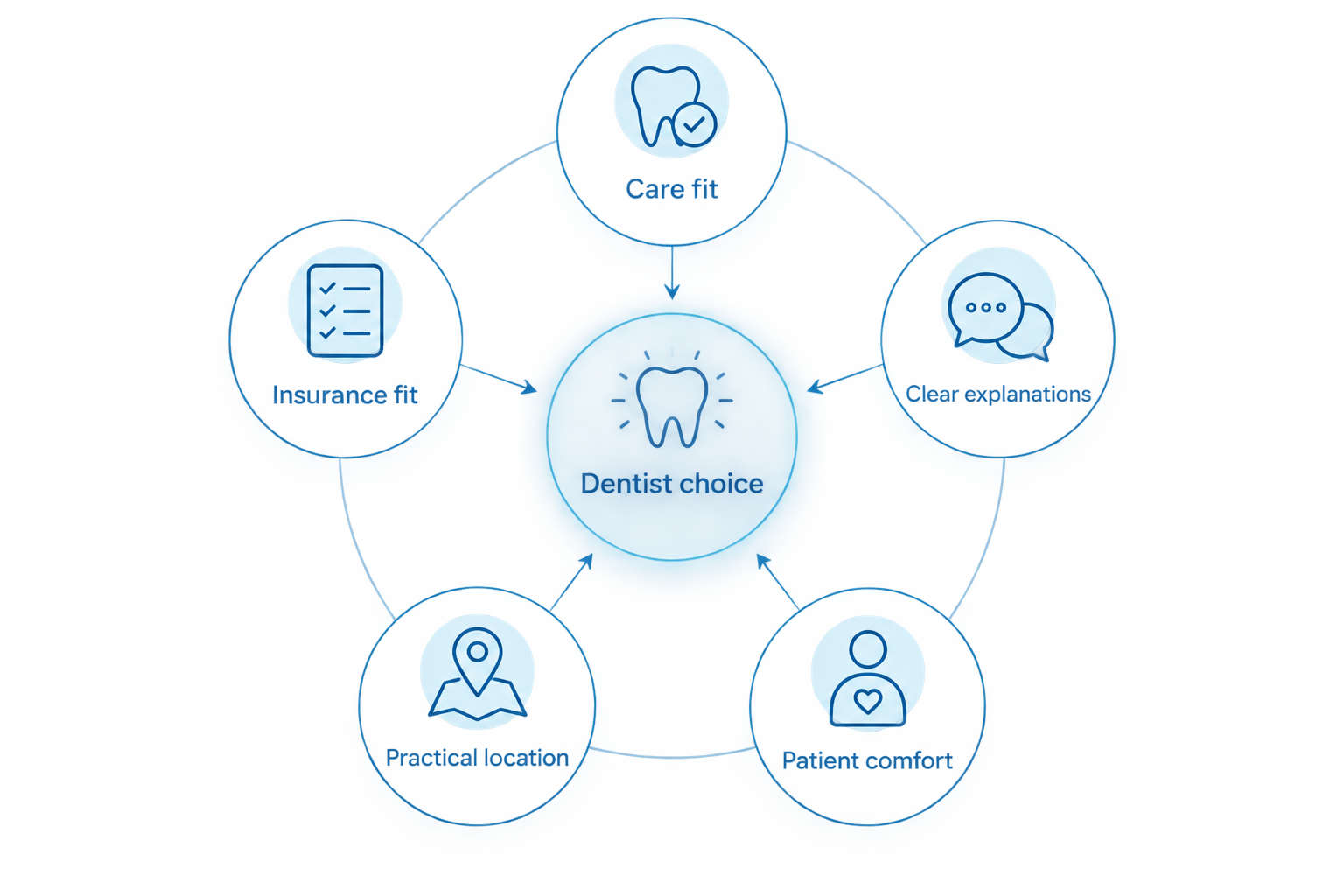
Use these five criteria before choosing an office:
Care fit: The office treats your main concern, whether that is a routine exam, a broken tooth, or missing teeth.
Insurance fit: The office and insurer confirm participation in your specific plan, not just the insurance company’s name.
Clear explanations: The dentist explains findings, alternatives, and what needs attention first in plain language.
Practical location: You can return for follow-up care without an unrealistic trip around work or family responsibilities.
Patient comfort: You can discuss anxiety, health conditions, accessibility needs, and questions without feeling rushed.
An appealing review score does not answer all five questions. Read comments for details about communication and follow-up, then verify the facts that affect your own visit.
Choose an office that fits your care needs and the follow-up visits you can realistically attend.
New-patient dental options at a glance
The order below starts with a local family practice, then separates options by patient need. It does not imply that every office within a category offers the same services or payment arrangements.
Option
Best for
Standout feature
Key limitation
Affordable Dentist Near Me
Families in its six listed Texas cities
General, cosmetic, and restorative dental services
Confirm the services and insurance arrangements at your chosen location
In-network general dentist
Patients prioritizing their existing dental benefits
Care coordinated around a verified insurance network
Network participation does not guarantee coverage for every procedure
Pediatric dentist
Children needing child-focused dental care
Dentistry focused on children’s oral health
Parents generally need a separate dentist for their own treatment
Urgent dental practice
Patients with a new toothache, broken tooth, or swelling
Assessment focused on an immediate dental problem
An urgent visit does not replace ongoing preventive care
Community health center
Patients exploring eligibility-based assistance
A place to ask about income-based dental programs
Dental services and eligibility requirements differ by center
1. Affordable Dentist Near Me: best for local family dental care
Affordable Dentist Near Me provides general, cosmetic, and restorative dental care for families in Fort Worth, Dallas, Houston, Waco, Grand Prairie, and Crowley. Its stated services include implants, crowns, braces, and teeth whitening.
Affordable Dentist Near Me is a practical starting point for families seeking general, cosmetic, and restorative dental care in its six listed Texas cities. Contact your chosen office about your specific concern before arranging a visit.
Practice pros:
Serves families across several named Texas communities.
Offers general care alongside cosmetic and restorative services.
Includes options for damaged teeth, missing teeth, and smile concerns.
Practice considerations:
The listed cities do not cover every Texas community.
You still need location-specific answers about insurance, age groups treated, and the services relevant to you.
Best for: Families in the listed cities who want to discuss routine care and longer-term dental needs with a local practice.
Verdict: Hold your final choice until the office confirms your care needs and insurance fit.
2. In-network general dentist: best for using existing benefits
An in-network general dentist is a sensible starting point when your priority is using a dental plan you already have. General dentists assess oral health, provide routine treatment, and refer patients when specialist care is needed.
Start with your insurer’s directory, then verify the individual dentist and office directly. A practice name alone is not enough to establish network participation.
In-network general dentist pros:
Gives you a clear starting point for checking plan benefits.
Supports routine exams and ongoing dental care.
Provides an initial assessment before specialist treatment when appropriate.
In-network general dentist cons:
Your plan can still have exclusions, waiting periods, or benefit limits.
A network listing does not establish whether the dentist is the right fit for your concern.
Ask about the procedure being recommended, not simply whether the office takes your insurance. For your 2026 benefits, have your insurer explain any applicable deductible, annual benefit limit, and prior-authorization requirements.
Best for: Insured adults who want to verify benefits before starting routine or restorative care.
Verdict: Hold until the insurer and office agree on the dentist’s network status.
3. Pediatric dentist: best for child-focused care
A pediatric dentist focuses on children’s dental health, including care from infancy through adolescence. This is a distinct choice when your main concern is your child’s comfort, development, or ability to participate in an examination.
A family dentist can also treat children. Ask which ages the office sees and explain any previous difficult dental experiences before deciding.
Pediatric dentist pros:
Focuses on children’s oral health and development.
Provides a setting centered on younger patients.
Offers a relevant starting point for discussing a child’s dental anxiety or additional care needs.
Pediatric dentist cons:
Parents generally need separate arrangements for their own dental treatment.
Child-focused care does not automatically mean a particular insurance plan is accepted.
The American Academy of Pediatric Dentistry recommends a first dental visit when the first tooth appears and no later than the first birthday. For a child already past that point, arrange an evaluation rather than waiting for pain.
Best for: Families whose priority is a child’s dental care rather than shared adult-and-child appointments.
Verdict: Hold until the office confirms the child’s age, care needs, and insurance fit.
4. Urgent dental practice: best for a new dental problem
An urgent dental practice is the relevant option when pain, a broken tooth, or swelling changes the purpose of your search. Describe the symptoms when you contact the office so staff can direct your next step.
Do not book a routine cleaning and assume it will address a painful tooth. An examination is needed to identify the cause and appropriate treatment.
Urgent dental practice pros:
Focuses the initial conversation on the immediate problem.
Provides a route to professional assessment rather than self-diagnosis.
Helps establish what follow-up dental treatment is needed.
Urgent dental practice cons:
An initial assessment does not mean every treatment can be completed during that visit.
You still need a plan for preventive care after the urgent problem is addressed.
Trouble breathing or swallowing, or swelling affecting your neck or eye, requires emergency medical attention. Do not delay emergency care while comparing dental offices online.
For other concerning symptoms, explain what hurts, when it started, and whether you have swelling or fever. The guide to recognizing a dental emergency provides additional context.
Best for: Patients whose immediate priority is a new painful or damaged tooth.
Verdict: Skip routine appointment shopping when symptoms need prompt professional assessment.
5. Community health center: best for checking assistance eligibility
A community health center is an option to investigate when you need help identifying dental assistance programs. Federally funded health centers use income-based sliding-fee arrangements for eligible patients; confirm whether a particular center provides dental care.
Ask about the application process and the treatment you need. Do not assume that every community clinic offers dental services or handles every procedure.
Community health center pros:
Provides a starting point for asking about income-based assistance.
Lets you discuss eligibility before committing to a treatment pathway.
Offers an alternative to choosing solely from private dental practices.
Community health center cons:
Eligibility requires documentation and a center-specific assessment.
Dental service scope differs, especially for specialist or cosmetic treatment.
Best for: Patients who want to check eligibility-based support before selecting a private practice.
Verdict: Hold until the center confirms dental services and explains its eligibility requirements.
How to turn your search into the right first visit
Keep your 2026 search focused: compare 2 offices, ask 3 questions, and request 1 written treatment plan if treatment is recommended. These are practical comparison steps, not rules about how much care you need.
Compare 2 offices that match your main concern
Choose offices that fit the same need. Comparing a pediatric office with an implant-focused consultation does not help you choose routine adult care.
Check the office location and the dentist’s license through the relevant state licensing board. Use reviews as context for communication—not proof of treatment quality.
Ask 3 questions before committing
Is this office accepting new patients for my age group and reason for visiting?
Is this dentist at this location in-network with my exact plan?
What is included in the initial appointment, and what requires a separate visit?
Tell the office about pain, anxiety, pregnancy, medical conditions, and medications. Do not stop a prescribed medicine because you are planning dental treatment; discuss medication questions with your treating clinicians.
Request 1 written treatment plan
If the examination identifies problems, ask the dentist to separate urgent needs from treatment that can be planned. Request an explanation of alternatives and the consequences of delaying recommended care.
Bring your insurance information, medication list, and relevant dental records. Ask your previous office how to transfer records rather than assuming every image or document must be repeated.
How these options were ranked
This guide ranks care pathways by fit: local family care first, followed by insurance-focused, child-focused, urgent, and assistance-focused options. The criteria are care scope, insurance verification, communication, location, and comfort—not unverified review totals or claims about clinical results.
A dentist’s recommendation still depends on an examination. A search result cannot determine whether you need a filling, crown, extraction, or another treatment.
Which dentist should you choose?
Choose Affordable Dentist Near Me as a starting point for family dental care if you live in one of its listed Texas cities. Ask the specific office about your needs before making your decision.
Choose a pediatric dentist when child-focused care is the priority, an urgent dental practice for a new dental problem, or a community health center when you need to explore assistance eligibility. For insured routine care, verified network participation belongs near the top of your checklist.
FAQ
How do I find a dentist accepting new patients near me in 2026?
Identify nearby offices that treat your main concern, then contact them directly about new-patient registration. Confirm your age group, exact insurance plan, and what the initial appointment includes before committing.
Which dentist should I contact for family care in Texas?
Affordable Dentist Near Me is a starting point for families in Fort Worth, Dallas, Houston, Waco, Grand Prairie, and Crowley. Ask your chosen location about the care each family member needs and verify insurance details.
Does accepting my insurance mean a dentist is in-network?
No. An office can submit claims without being in-network, so ask your insurer to verify the individual dentist and office location under your specific plan.
Can a new patient get a cleaning at the first visit?
Ask the office whether the first appointment includes a cleaning or begins with an examination. Your dentist must assess your oral health to determine the appropriate type of cleaning and treatment.
Should I choose a family dentist or a pediatric dentist for my child?
Choose according to your child’s needs and the office’s experience with that age group. A pediatric dentist focuses on children, while a family dentist can provide care for different family members; confirm the ages treated.
What should I bring to a first dental appointment?
Bring your medication list, insurance information, relevant medical history, and any requested identification or forms. Ask how to transfer previous dental records before the visit.
Should I wait for a routine appointment if my face is swollen?
Contact a dental professional promptly about facial swelling. Trouble breathing or swallowing, or swelling affecting the neck or eye, requires emergency medical attention rather than routine appointment shopping.
One last thing
Your first visit does not obligate you to agree to every nonurgent procedure immediately. Ask the dentist to show you the findings and explain which problems need attention first.
For your 2026 decision, the most useful answer is not simply that an office sees new patients. It is a clear explanation of how that office will evaluate your concern and help you decide what comes next.