Best overall starting point: a Tyler general dentist who provides a written treatment plan. Best for insured patients: a dentist confirmed in your exact network. Best budget route to investigate: income-based dental assistance. This 2026 guide helps you compare care options without treating an unverified provider list as a ranking.
TL;DR
For a dentist tyler tx search, start with a local general dentist and request a written treatment plan.
Confirm your exact insurance network before choosing a family dentist; accepting insurance does not establish network participation.
Investigate income-based dental assistance, but confirm eligibility and covered services before arranging care.
Affordable Dentist Near Me serves six named Texas cities; Tyler is not among its listed locations.
Why this matters
Affordable dental care means understanding the complete treatment plan, not choosing from an advertised headline. An examination, necessary images, treatment, and follow-up are different parts of care. Ask which parts your written estimate includes before agreeing to treatment.
A search for “dentist tyler tx” also needs a location check. Affordable Dentist Near Me provides general, cosmetic, and restorative dental care in Fort Worth, Dallas, Houston, Waco, Grand Prairie, and Crowley. Tyler is not among those listed service cities; do not assume the practice has a Tyler office.
This guide ranks care routes by patient need, not named Tyler practices by quality or affordability. Choose the route that fits your situation, then verify the individual dentist, location, benefits, and treatment recommendation.
What makes the best affordable dentist in Tyler?
Use these criteria for your 2026 shortlist. A dentist should explain the clinical recommendation; the office should explain the financial details.
Clear treatment priorities: Ask what needs prompt attention, what needs monitoring, and what is optional.
Complete written estimate: Request an itemized plan that separates treatment, expected insurance payments, and your estimated responsibility.
Verified credentials: Check the treating dentist’s license through the Texas State Board of Dental Examiners. A practice name is not an individual credential.
Exact benefit confirmation: Verify the dentist, office address, and insurance plan together. Network participation is more specific than accepting insurance.
Practical follow-up: Consider travel, return appointments, record access, and who handles concerns after treatment.
Understandable alternatives: Ask about reasonable alternatives, their disadvantages, and the consequences of delaying care.
Do not turn these criteria into a checklist that overrides symptoms. Facial swelling with trouble breathing or swallowing requires emergency medical attention, not extended comparison shopping.
Tyler dental care options at a glance
The order below starts with routine care and then separates patients by insurance, financial eligibility, age, and treatment complexity. These are decision routes, not promises that a particular Tyler office offers each arrangement.
Care route
Best for
Standout feature
Key limitation
Local general dentist
Routine adult dental care
A starting point for examination and treatment planning
Services and referral needs differ by office
Confirmed in-network dentist
Patients using dental insurance
Treatment planning tied to the exact benefit plan
Network status does not establish procedure coverage
Income-based dental assistance
Patients needing help beyond insurance
Eligibility screening for possible assistance
Eligibility and services require confirmation
Pediatric dentist
Children needing child-focused care
Specialty focus on children’s oral health
Parents need a separate adult-care arrangement
Restorative treatment consultation
Missing teeth or extensive tooth damage
Comparison of repair and replacement approaches
Planning can involve multiple treatment stages
1. Local general dentist: best for routine adult dental care
A general dentist is the default starting point for checkups, tooth concerns, and a treatment plan. An examination establishes what is happening before you commit to a cleaning, filling, crown, or referral.
Best for: Adults who need routine care or do not yet know which treatment they need.
When you contact a Tyler office, describe your main concern rather than requesting a procedure based only on an online search. Tell the office about pain, swelling, a broken tooth, or how long you have postponed care. Bring your medication list and relevant medical history to the appointment.
Local general dentist pros:
Gives you a starting point for diagnosis and treatment priorities.
Supports ongoing care at a location you can revisit.
Helps identify when a specialist’s assessment is appropriate.
Local general dentist cons:
The office does not necessarily provide every procedure.
An initial estimate can change when examination findings establish additional needs.
Ask for 1 written treatment plan you can review after the visit. That is a practical comparison tool, not a requirement to accept every recommended procedure immediately.
Verdict — Buy: Choose an initial examination when the location, credentials, and explanation of the visit meet your needs; decide on treatment after discussing the findings.
2. Confirmed in-network dentist: best for insured patients
For an insured patient, network verification belongs before treatment planning. A dentist who accepts claims from an insurer is not necessarily contracted with your particular plan.
Best for: Patients who want to use existing dental benefits and understand their estimated responsibility.
For a 2026 appointment, confirm current participation with both the insurer and the office. Give them the treating dentist’s name, office address, and exact plan information. Ask whether deductibles, annual limits, waiting periods, exclusions, or prior authorization affect the proposed procedure.
Confirmed in-network dentist pros:
Connects your provider choice to your specific insurance arrangement.
Gives you a basis for asking about estimated benefits before treatment.
Helps separate covered care from excluded or limited services.
Confirmed in-network dentist cons:
Network participation does not guarantee payment for a procedure.
A benefit estimate is not the same as a final claim decision.
Ask the office whether it can submit a pretreatment estimate for substantial planned work. Keep the insurer’s response with your treatment documents, and read any limitations rather than relying only on a verbal summary.
Verdict — Buy: Choose the confirmed in-network route when the dentist also meets your clinical and follow-up needs; do not choose on network status alone.
3. Income-based dental assistance: best for financial-eligibility screening
If ordinary payment arrangements do not fit your circumstances, investigate income-based assistance before committing to nonurgent treatment. Ask a prospective community clinic or assistance program whether it provides dental care, which eligibility rules apply, and what documentation it requires.
Best for: Patients who need financial assistance rather than simply a different way to pay.
This route does not identify a verified Tyler program or establish that you qualify. Start by confirming the program itself and its current dental services. For broader preparation, review these dental care options for uninsured patients.
Income-based dental assistance pros:
Opens a discussion about help based on financial circumstances.
Separates assistance eligibility from insurance enrollment.
Lets you establish required documents before arranging a visit.
Income-based dental assistance cons:
Eligibility rules can exclude an applicant.
A program’s dental services do not necessarily include every recommended treatment.
Ask 3 questions: Who qualifies? Which dental services are included? What remains the patient’s responsibility? For Medicaid, verify your specific eligibility and dental benefits rather than assuming enrollment covers all adult treatment.
Verdict — Hold: Confirm eligibility and the relevant service before choosing this route; do not postpone urgent assessment while seeking assistance.
4. Pediatric dentist: best for children needing child-focused care
A pediatric dentist specializes in children’s oral health. This route deserves consideration when your child needs a child-focused approach, has difficulty with dental visits, or has needs that your general dentist recommends assessing with a specialist.
Best for: Children whose care needs call for a pediatric dental setting.
Ask how the office handles a first visit, parental involvement, behavior support, and referrals. Explain your child’s medical conditions, medications, communication needs, and previous dental experiences before the appointment. Those details help the dentist plan an appropriate assessment.
Pediatric dentist pros:
Provides a specialty focus on children.
Gives you a setting for discussing age-specific oral health concerns.
Supports planning around a child’s individual treatment needs.
Pediatric dentist cons:
Does not solve the parents’ need for adult dental care.
Specialty training does not establish insurance participation or financial fit.
A family dentist is another route for children; ask which ages the office treats and whether the dentist is comfortable managing your child’s needs. Do not assume every child needs a specialist or that every family practice treats every age.
Verdict — Buy: Choose a pediatric assessment when your child’s needs or a referral support it; otherwise, discuss routine care with a suitable family dentist.
5. Restorative treatment consultation: best for missing or damaged teeth
Missing teeth and extensively damaged teeth require a treatment comparison, not a decision based on a procedure name. A restorative consultation should explain whether a tooth can be repaired and which replacement approaches fit the examination findings.
Best for: Patients considering crowns, implants, bridges, or dentures after a clinical assessment.
Affordable Dentist Near Me provides restorative dental services, including implants and crowns, in its listed service cities. For a Tyler resident, travel and follow-up belong in that decision; this is not a local-office recommendation.
Restorative consultation pros:
Creates room to compare repair and replacement approaches.
Helps separate immediate treatment from later restorative stages.
Gives you an opportunity to discuss maintenance and follow-up.
Restorative consultation cons:
Not every approach is suitable for every patient.
Treatment can require several appointments and coordination between providers.
For extensive nonurgent work, compare 2 written plans when you need a second opinion. Ask both dentists to explain differences in diagnosis, treatment scope, and follow-up rather than comparing totals alone.
Verdict — Hold: Commit to a restorative procedure after you understand the diagnosis, alternatives, treatment stages, and ongoing care.
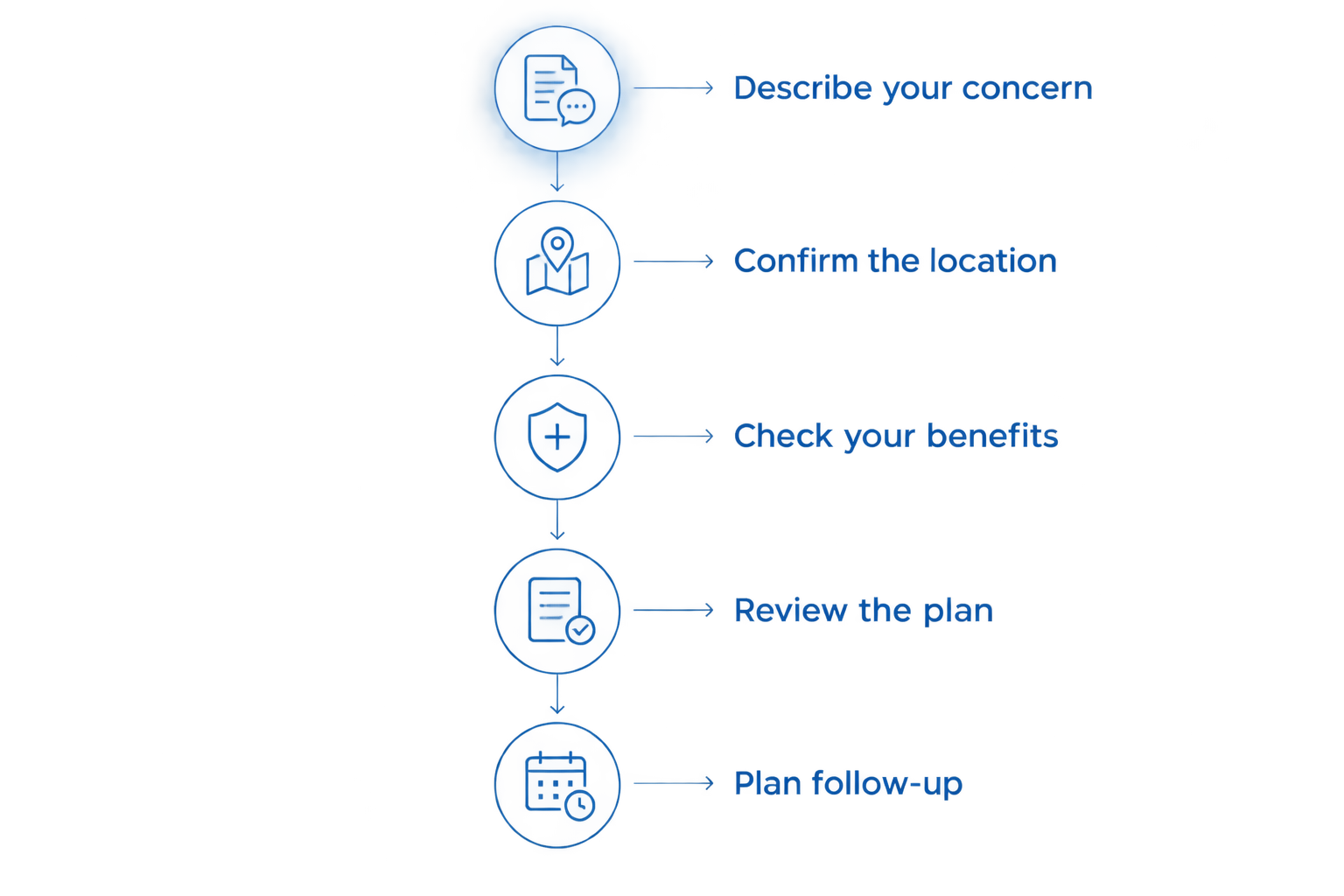
How to compare your final choices in 2026
Use the same information when you speak with each office. Comparing unlike appointments or different treatment scopes does not tell you which option fits better.
Describe your concern. State your symptoms, priorities, and relevant medical information.
Confirm the location. Verify the actual office and treating dentist rather than relying on a search result’s city label.
Check your benefits. Confirm the exact plan or assistance arrangement and its limitations.
Review the plan. Request the diagnosis, recommended treatment, alternatives, and itemized estimate.
Plan follow-up. Establish who handles questions, adjustments, and complications after treatment.
Keep your questions in writing so the discussion stays focused. If you are comparing a local Tyler dentist with an out-of-town practice, include the practical demands of returning for care; the treatment appointment is not always the whole process.
How these care routes are ranked
The ranking follows treatment clarity, benefit verification, financial eligibility, patient needs, and follow-up. General dentistry comes first because it is a starting point for routine adult assessment; the remaining options answer distinct needs rather than compete for the same patient.
No named Tyler dentist receives a quality, affordability, or review ranking here. A useful 2026 choice requires current, office-specific information and an examination where treatment is concerned.
Which dentist should you choose?
Choose a local general dentist by default, then change routes when your insurance, financial circumstances, child’s needs, or treatment complexity calls for it. Prioritize a clear explanation and a written plan over a promotional claim.
Affordable Dentist Near Me is an option for family dental care in its six listed Texas service cities, not a confirmed Tyler location. If you are considering travel, contact the office for more information about your specific treatment needs and follow-up arrangements.
FAQ
What’s the best affordable dentist in Tyler, TX?
The best starting point is a local general dentist who verifies your benefits and provides a clear written treatment plan. This guide does not establish a named Tyler practice as the lowest-cost or highest-quality provider.
Does Affordable Dentist Near Me have a Tyler office?
Tyler is not among Affordable Dentist Near Me’s listed service cities. The listed cities are Fort Worth, Dallas, Houston, Waco, Grand Prairie, and Crowley.
How do I compare dentists if I don’t have insurance?
Request an itemized treatment plan and ask which care is urgent, which can be staged, and what assistance arrangements apply. Compare equivalent treatment scopes rather than different procedures or incomplete estimates.
Is a dentist who accepts my insurance always in-network?
No, accepting insurance does not establish participation in your exact network. Confirm the treating dentist, office address, and plan with both the insurer and the dental office.
Should I choose a family dentist or a pediatric dentist for my child?
Choose according to your child’s needs and the dentist’s ability to provide appropriate care. A pediatric dentist offers specialty care for children; a family dentist is another option when the office treats your child’s age group and needs.
Should I get a second opinion before major dental work?
A second opinion is a reasonable step when you need clarification before extensive nonurgent treatment. Ask each dentist to explain the diagnosis, alternatives, and differences between the written plans.
Can I wait to compare offices if my face is swollen?
Facial swelling needs prompt assessment, and swelling with trouble breathing or swallowing requires emergency medical attention. Do not delay urgent care to finish comparing dental offices.
One last thing
Ask: “If this were divided into stages, what must happen first?” That question helps distinguish clinical urgency from the order of an estimate without asking the dentist to skip necessary care.
For your 2026 appointment, take the written answer home with your treatment plan. Understanding the next necessary step is more useful than agreeing to a complete plan you do not understand.