Best starting point for a general implant evaluation: Affordable Dentist Near Me. Best for complex tooth-replacement planning: a restorative specialist. Best for surgical risk assessment: an implant surgeon. For all-on-4 dental implants in Houston in 2026, choose the provider whose written plan explains your suitability, replacement teeth, and follow-up—not just the procedure name.
TL;DR
Affordable Dentist Near Me is a starting point for Houston implant evaluations; confirm full-arch services before booking.
For all-on-4 dental implants Houston searches, compare clinical suitability, surgical responsibility, replacement teeth, and ongoing care.
Choose a restorative specialist for complex bite planning and an implant surgeon for surgical concerns.
Fixed full-arch teeth and removable implant-supported dentures are different treatments; ask which your plan includes.
Why this matters
All-on-4 describes a full-arch treatment concept using 4 implants per arch to support fixed replacement teeth. Treating 1 arch means replacing the upper or lower row; treating 2 arches means addressing both. Your examination determines whether this approach fits your mouth.
A provider directory cannot make that decision. Bone support, gum health, remaining teeth, medical history, and your ability to clean the restoration all matter.
This 2026 guide ranks consultation pathways by patient need, not named Houston surgeons by unverified results. A general dental practice, restorative specialist, and surgical team serve different roles, and some treatment plans involve more than one.
What makes the best All-on-4 provider?
Use these criteria before choosing where to begin:
Clinical suitability: The dentist examines your mouth and explains why fixed full-arch treatment fits—or why another option is better.
Clear responsibility: You know who places the implants, makes the teeth, and handles problems afterward.
Restoration planning: The plan addresses speech, appearance, bite, and cleaning access, not surgery alone.
Written treatment scope: Extractions, imaging, temporary teeth, final teeth, and follow-up are clearly distinguished.
Long-term care: The team explains home cleaning, professional maintenance, repairs, and warning signs.
Practical follow-up: You can realistically attend appointments in Houston throughout treatment and afterward.
The best provider explains the limits of treatment as clearly as the benefits. A promise of fixed teeth without an examination is not a substitute for a diagnosis.
Houston implant consultation options at a glance
Consultation option
Best for
Standout role
Key limitation
Affordable Dentist Near Me
Starting with a general and restorative dental evaluation
Houston family dental care that includes implant services
Confirm full-arch treatment scope and the clinicians involved
Restorative specialist
Complex bite and replacement-tooth planning
Planning how replacement teeth fit, function, and look
Surgical treatment can involve another clinician
Implant surgeon
Bone loss, extraction, or medical-risk questions
Evaluating the surgical part of treatment
Surgery alone does not define the final teeth
Implant-supported denture provider
Comparing removable teeth with fixed full-arch teeth
Evaluating a removable implant-supported alternative
Removable dentures do not function or clean exactly like fixed teeth
The table separates provider roles, not quality levels. Your strongest choice is the team that covers every part of your treatment without leaving responsibility unclear.
1. Affordable Dentist Near Me: best for an initial implant evaluation
Affordable Dentist Near Me provides general, cosmetic, and restorative dentistry, including implants, and serves families in Houston. That makes the practice a starting point when you need an examination and want to discuss tooth replacement alongside your other dental needs.
Affordable Dentist Near Me is best for Houston families starting with a general and restorative dental evaluation. Before booking an All-on-4 consultation, confirm that the Houston office evaluates fixed full-arch cases and ask who would provide each treatment stage.
Practice pros:
Serves Houston patients.
Offers implant services within a broader dental practice.
Provides a starting point for discussing remaining teeth and restorative needs together.
Practice limitations:
General implant services do not establish the scope of full-arch treatment; confirm that directly.
The practice description does not establish which clinician would perform your surgery or make your final teeth.
Best for: Patients who need a first examination rather than a predetermined surgical solution.
Bring your medication list, relevant medical history, and any existing dental records. Explain whether your main concern is loose dentures, painful teeth, chewing, appearance, or several of these together.
Verdict: Hold off on committing to All-on-4 until an examination establishes the treatment and team you need.
2. A restorative specialist: best for complex replacement-tooth planning
A prosthodontist is a dentist with advanced specialty training in restoring and replacing teeth. This consultation focuses on how a full-arch restoration will fit your mouth, support your bite, and meet your daily needs.
That perspective matters when the challenge goes beyond replacing missing teeth. Changes in bite, limited space for a restoration, or dissatisfaction with an existing denture deserve specific attention before surgery is planned.
Restorative specialist pros:
Focuses on replacement-tooth design and function.
Evaluates bite, speech, appearance, and cleaning access together.
Can explain fixed and removable restoration choices.
Restorative specialist limitations:
Implant surgery can require coordination with another clinician.
Specialty training does not replace an individual assessment of your suitability.
Best for: Patients with complicated bite concerns, an unsatisfactory existing restoration, or questions about the final teeth.
For a 2026 consultation, ask to see how temporary and final teeth differ in your proposed plan. Request an explanation of how the team checks speech and bite before completing treatment.
Verdict: Hold surgical consent until the replacement-tooth plan is clear.
3. An implant surgeon: best for bone and surgical-risk questions
An oral and maxillofacial surgeon or periodontist can assess surgical concerns involving implants. These include the condition of the supporting bone, extraction planning, and health factors that affect treatment.
The consultation should connect surgery to the intended restoration. Correct implant placement must serve the planned teeth, rather than leave the restorative dentist to work around an unexplained surgical decision.
Implant surgeon pros:
Evaluates surgical anatomy and implant placement needs.
Addresses extraction and bone-related questions.
Reviews medical considerations relevant to surgery.
Implant surgeon limitations:
A surgical plan alone does not specify the final restoration.
Another clinician can be responsible for temporary teeth, final teeth, and maintenance.
Best for: Patients with known bone loss, complex extraction needs, or medical questions requiring focused surgical assessment.
Do not stop prescribed medication on your own. Give the team a complete medication list and ask whether coordination with your medical clinician is needed.
Verdict: Wait for a coordinated surgical and restorative plan before choosing a procedure.
Understand the treatment sequence before choosing a provider
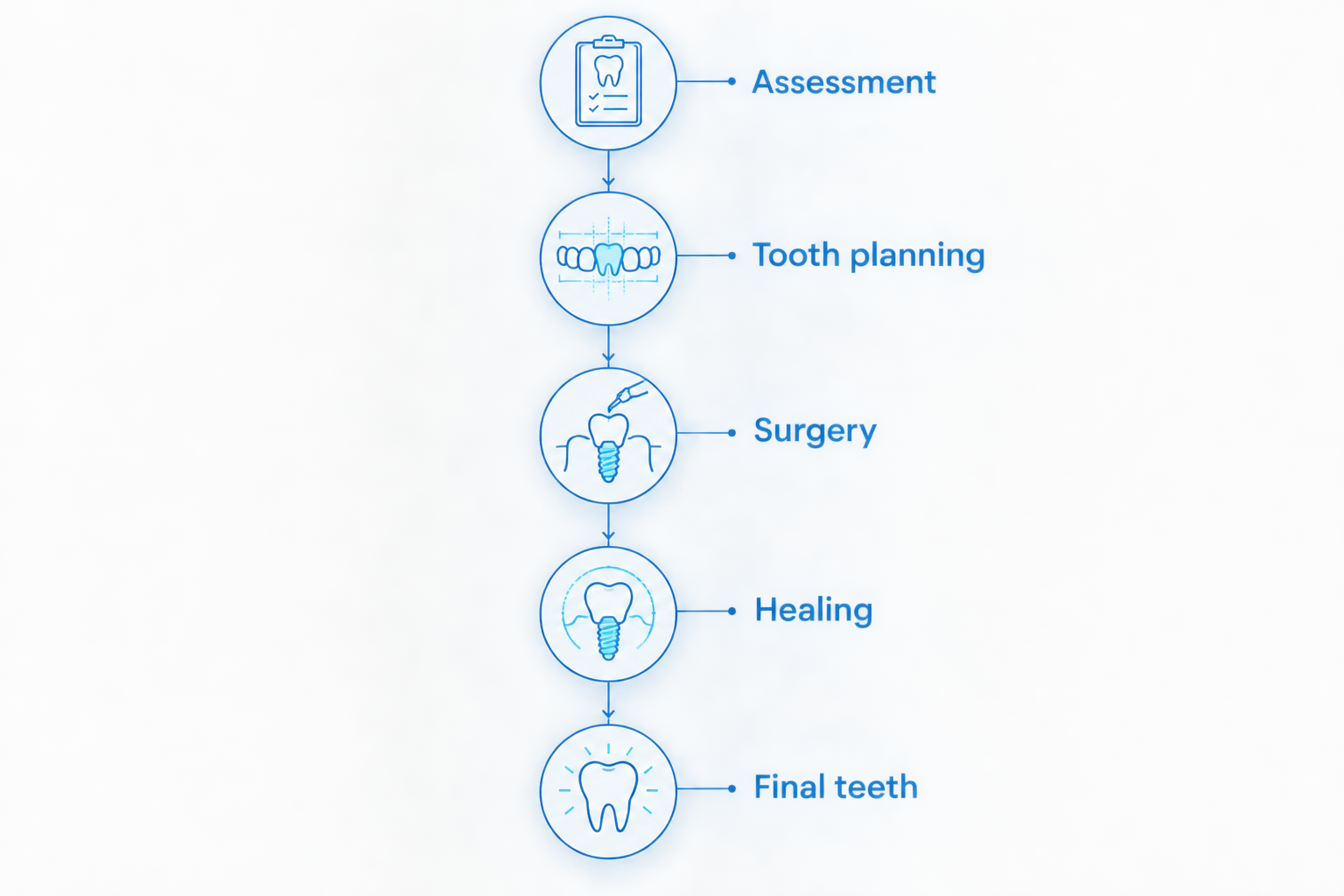
A clear All-on-4 plan connects the examination to long-term care. Ask each Houston office to explain these stages in plain language:
Assessment: Review your health, gums, teeth, bite, and diagnostic images.
Tooth planning: Decide what the replacement teeth need to do and how they will be cleaned.
Surgery: Explain implant placement, necessary extractions, and any additional procedures.
Healing: Set instructions for eating, cleaning, follow-up, and reporting problems.
Final teeth: Explain when the final restoration is appropriate and how it will be maintained.
The replacement-tooth plan belongs before surgery, not after it.
A same-day temporary restoration is not the same thing as completed healing or final teeth. Ask what you would leave with after surgery and what conditions must be met before fixed temporary teeth are fitted.
For treatment beginning in 2026, request written instructions rather than relying on a verbal summary. Your plan should identify whom to contact if a temporary tooth breaks, your bite feels wrong, or symptoms worsen.
4. An implant-supported denture provider: best for comparing removable alternatives
An implant-supported denture consultation helps you compare removable replacement teeth with a fixed full-arch restoration. The key distinction is daily use: a removable denture comes out for cleaning, while fixed teeth require cleaning around and underneath the restoration.
Neither approach is automatically right for every patient. Your dentist should discuss bone support, hand movement, cleaning ability, comfort, and the condition of the opposing teeth.
Implant-supported denture provider pros:
Broadens the discussion beyond fixed teeth alone.
Allows comparison of different cleaning routines.
Helps match the restoration to your everyday needs.
Implant-supported denture provider limitations:
A removable restoration is not equivalent to fixed full-arch teeth.
Attachments and denture components require ongoing care and maintenance.
Best for: Patients who want to compare removable teeth with a fixed restoration before deciding.
Comparing implant-supported denture options means comparing how the teeth attach, whether you remove them, and what maintenance the attachments need. The word implants alone does not tell you how the finished teeth will work.
Verdict: Hold the fixed-versus-removable decision until you understand both cleaning routines and maintenance responsibilities.
Compare written treatment plans, not procedure labels
Your 2026 shortlist should become a comparison of treatment plans. A familiar procedure name does not establish that different offices are proposing the same care.
Ask each provider to identify:
Treatment area: Upper arch, lower arch, or both.
Remaining teeth: Which teeth can be preserved and why extraction is recommended for others.
Temporary teeth: Whether they are fixed or removable and what would change that plan.
Final restoration: The proposed material, design, and maintenance requirements.
Team responsibility: Who handles surgery, bite adjustments, repairs, and routine follow-up.
Additional treatment: Whether gum treatment, bone procedures, or other preparation is needed.
Keep clinical decisions separate from payment decisions. First understand the recommended treatment and alternatives; then request an itemized estimate and written payment terms.
If an office discusses insurance, ask what has actually been verified with your plan. A general statement that an office accepts insurance does not establish benefits for full-arch implant treatment.
How these consultation pathways are ranked
The order follows the decision you need to make: establish your overall dental needs, resolve complex restoration questions, address surgical concerns, and compare removable alternatives. It does not represent measured treatment outcomes or a ranking of individual Houston clinicians.
The criteria remain the same across all pathways: suitability, clear responsibility, restoration planning, written scope, maintenance, and practical follow-up. Choose the consultation that addresses your main unanswered question.
Which Houston implant provider should you choose?
Start with an examination, not a commitment to a procedure. Affordable Dentist Near Me is an option for Houston patients seeking a general implant evaluation; confirm the office's full-arch services before booking.
Choose a restorative specialist when your biggest concern is the final bite or replacement teeth. Choose a surgical consultation when bone support, extractions, or medical considerations need focused assessment.
For all-on-4 dental implants in Houston in 2026, the deciding factor is a coordinated plan you understand. Do not proceed until you know who is responsible from the first assessment through ongoing care.
FAQ
Who’s the best provider for all-on-4 dental implants in Houston?
The best fit is a provider whose examination supports the treatment and whose team explains surgery, replacement teeth, and follow-up clearly. Affordable Dentist Near Me offers implant services and serves Houston; confirm full-arch services and the treating clinicians before booking.
Should I choose a general dentist or a specialist for All-on-4?
Choose according to your clinical needs and the treatment team’s responsibilities. A general dentist can assess your overall needs, while a restorative specialist or surgeon can address more complex restoration or surgical questions.
Does All-on-4 replace my upper and lower teeth?
All-on-4 treatment is planned per arch, so an upper restoration does not also replace the lower teeth. Ask whether your proposed plan covers the upper arch, lower arch, or both.
Can I get fixed teeth on the day of implant surgery?
Some patients qualify for fixed temporary teeth on the day of surgery, but not everyone does. The decision depends on clinical findings and implant stability, and temporary teeth are not the final restoration.
Are snap-in dentures the same as All-on-4?
No, removable snap-in dentures and fixed full-arch implant teeth are different restoration types. Ask whether you remove the teeth yourself and how the attachments or spaces underneath are cleaned.
What should I bring to an implant consultation?
Bring your medication list, medical history, existing dental records, and questions about your main concerns. Tell the dentist about tobacco use, diabetes, previous implant problems, and difficulty cleaning your teeth.
Can I get All-on-4 if I have gum disease or bone loss?
Gum disease or bone loss requires assessment before an implant treatment decision. Your dentist must determine whether preliminary treatment, a different implant approach, or another tooth-replacement option is appropriate.
One last thing
Ask the provider to demonstrate how you would clean underneath the proposed fixed teeth. This simple request turns an abstract treatment discussion into something you can assess: whether the restoration fits your daily abilities and routine.
Fixed teeth still need cleaning and professional maintenance. A plan that explains surgery but leaves everyday care unclear is not ready for your decision.