Yes. A cosmetic dentist can make mildly crooked teeth look straighter without braces by changing their visible shape with bonding or veneers. Those treatments do not move the teeth or correct a bite problem; if the teeth need to move, clear aligners may be an alternative to braces after a dental assessment.
TL;DR
A cosmetic dentist can fix the appearance of mildly crooked teeth without braces, but bonding and veneers do not move teeth.
Clear aligners move teeth without braces; they are a better fit when alignment or bite needs correction.
Affordable Dentist Near Me is best for families seeking an assessment before choosing a cosmetic or orthodontic approach.
Can a cosmetic dentist fix crooked teeth without braces?
Yes, if the goal is to improve how mildly crooked teeth look. The right choice depends on whether you want to change a tooth’s visible shape or its actual position. A dentist needs to check your teeth and bite before recommending either route in 2026.
Option
What it changes
Best for
Main limitation
Dental bonding
The visible shape of a tooth
A small, uneven-looking edge or gap
Does not move the tooth; the added material can chip or stain
Veneers
The visible front surface of a tooth
Several visible shape or spacing concerns
Does not correct the bite; preparation can involve removing enamel
Tooth contouring
A small amount of tooth enamel
A minor uneven edge
Cannot add length or move teeth; removed enamel does not grow back
Clear aligners
Tooth position
Crooked teeth that need to move
Requires an assessment and consistent wear; not every case is suitable
Braces
Tooth position
Alignment or bite concerns that need orthodontic treatment
Visible hardware and ongoing adjustments
If you mean without metal braces rather than without moving your teeth, start with the orthodontic options for adults. Clear aligners and cosmetic surface treatments solve different problems, even when the smile you want looks similar.
Why this matters
A tooth can look crooked because it is rotated, because its edge is uneven, or because it sits out of line with its neighbors. Those are not interchangeable problems. Covering a visible irregularity can change your smile in 2026, but it cannot make a tooth meet its opposing tooth differently when you bite.
That distinction protects you from choosing a treatment for the wrong job. If your main concern is a small visible edge, moving several teeth could be more treatment than the appearance issue calls for. If you struggle to clean between overlapping teeth or your bite feels off, changing their front surfaces does not address the position behind the problem. Tell the dentist what you notice, not just which treatment you want.
A photo helps show what bothers you when you smile. It does not show how your teeth fit together or whether the tooth has enough healthy structure for a cosmetic change. Expect an in-person examination before treating a crooked-looking tooth as a purely cosmetic issue.
Bonding: a change to the visible tooth shape
Dental bonding uses tooth-colored material to alter part of a tooth’s appearance. It can soften the look of an uneven edge or make a small gap less noticeable. Best for: a limited appearance concern on a tooth that does not need to move.
Bonding is not a shortcut for every crooked tooth. Adding material to a tooth that already sticks out can make it look bulkier, and changing its surface does not resolve crowding or a bite issue. The material can also chip or stain. Ask the dentist to show you which part of the tooth would change and whether that change would affect how you bite.
Bonding also deserves a clear maintenance conversation. A result that looks good when you leave the chair still has to work when you eat, brush and clean between teeth. If the proposal involves building out several crowded teeth, ask whether moving them first would produce a more practical result. Verdict: choose bonding for a small visual correction, not for teeth that need repositioning.
Veneers: a new visible front surface
Veneers can change the apparent shape of front teeth and make certain spacing or unevenness concerns less obvious. They cover the visible surface; they do not move the tooth underneath. Best for: someone whose primary concern is the appearance of visible teeth and whose examination supports that approach.
The trade-off is permanent tooth preparation in many veneer plans. Enamel removal cannot be reversed, so it matters whether a tooth needs that change to achieve your goal. Veneers also need care and can require repair or replacement. Ask what will be changed on your natural teeth, what the proposed result will conceal, and what it will leave untouched.
Do not treat veneers as a substitute for correcting a bite. If a tooth sits far out of position, its new surface still has to fit alongside neighboring teeth and withstand normal use. A dentist might recommend addressing tooth position before considering any cosmetic finishing work. Verdict: consider veneers for a visible shape concern after ruling out alignment and bite needs.
Tooth contouring: a limited change to an edge
Tooth contouring removes a small amount of enamel to adjust a tooth’s shape. It can make an uneven edge look more consistent with the teeth beside it. Best for: a minor edge difference when the dentist confirms that removing enamel is appropriate.
This option has a narrow job. It cannot fill a gap, create space for crowded teeth or rotate a tooth into position. Enamel does not grow back, so ask the dentist to identify exactly what would be removed. If you need a larger change, contouring alone is not the answer. Verdict: choose contouring only when the visible edge, rather than tooth position, is the problem.
Clear aligners: straightening without braces
Clear aligners are an orthodontic option that moves teeth without brackets and wires. Unlike bonding, veneers and contouring, they address tooth position. Best for: someone who wants a straighter alignment and is a suitable candidate after a bite and dental-health assessment.
Aligners are not a purely cosmetic cover. You have to wear them as directed, attend the necessary checks and discuss how to maintain the result after treatment. They are not appropriate for every alignment problem. If you want to avoid braces, ask whether aligners can accomplish the movement your teeth need rather than assuming they will work from a photograph.
Braces also move teeth and remain an option when orthodontic treatment is needed. In 2026, the useful question is not which option looks less noticeable in a picture. It is which option can correct your tooth position and bite while fitting the treatment routine you can follow. Verdict: ask about clear aligners when the teeth need to move, not when only a minor edge needs changing.
How to choose between appearance and alignment
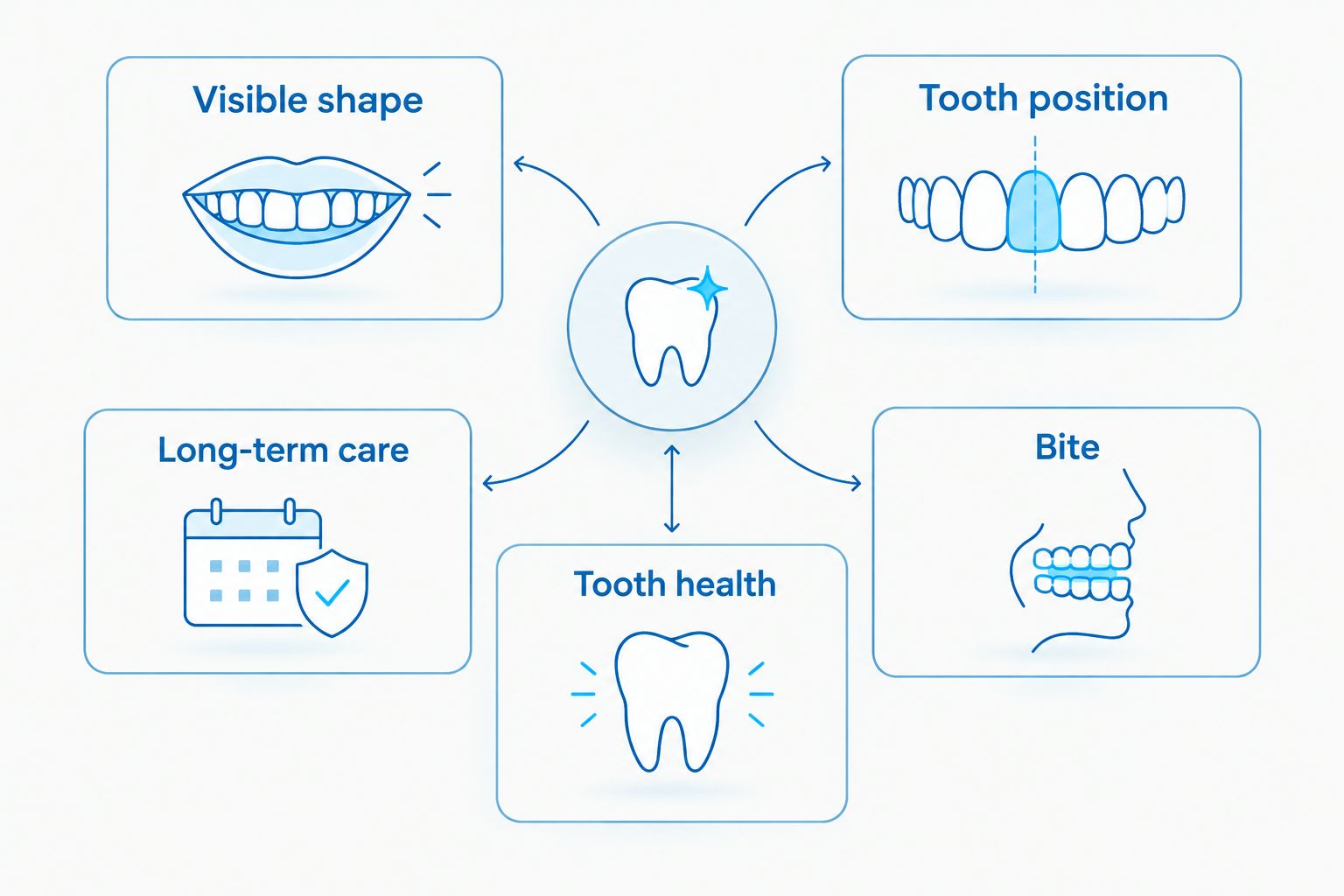
Start with the change you need, then discuss the treatment. This keeps a wish to avoid braces from turning into a surface treatment that leaves the underlying concern in place.
Visible shape: Point to the edge, gap or front surface that bothers you. Ask whether changing that surface would leave the tooth easy to clean and comfortable to bite with.
Tooth position: Show which teeth overlap, turn or sit forward. Ask whether moving them would address the concern more directly than covering it.
Bite: Tell the dentist if your teeth meet awkwardly or a particular tooth takes pressure when you close your mouth. A cosmetic change does not replace a bite assessment.
Tooth health: Mention chips, pain, bleeding gums or trouble cleaning around crowded teeth. Those concerns need attention before a smile-focused plan is settled.
Long-term care: Ask what the proposed treatment changes permanently and what maintenance it requires. Appearance on the day of treatment is only part of the decision.
Affordable Dentist Near Me is best for families in Fort Worth, Dallas, Houston, Waco, Grand Prairie and Crowley who want their cosmetic concern assessed alongside their dental care needs. The practice offers cosmetic dental care and braces; ask which services are appropriate for your teeth rather than choosing from a treatment name alone.
A change to visible shape is not the same as moving a tooth or correcting a bite.
At your visit, describe the result you want in plain terms: a less noticeable overlap, a more even edge, or a different-looking gap. Then ask the dentist to explain what is causing that appearance. You should be able to tell whether the plan changes the tooth’s surface, moves the tooth, or combines approaches. If that distinction is unclear, ask again before agreeing to treatment.
Why the right treatment varies
No single answer fits every crooked-looking smile in 2026. These factors determine whether a cosmetic dentist can improve the appearance without braces, or whether moving teeth deserves priority:
How far the tooth is out of position: A small visible irregularity and a tooth that sits well outside the line of the others call for different plans.
Whether the bite is affected: A surface change can alter what you see without fixing how your teeth meet.
Which teeth bother you: An uneven edge on one tooth is different from several crowded teeth.
How much healthy tooth must change: Veneers and contouring raise questions about enamel that aligners do not address in the same way.
Whether teeth are healthy enough for the plan: Pain, damage or gum concerns should be assessed rather than covered for appearance alone.
What care you can maintain: Bonding and veneers need upkeep; aligners require consistent wear and follow-up.
The most useful appointment question is: Will this treatment improve the appearance only, or will it correct the position causing it? A clear answer lets you weigh the visible result against changes to your natural teeth and the care required afterward.
Can veneers straighten crooked teeth permanently?
No. Veneers can make some crooked teeth look straighter, but they do not straighten or move the teeth underneath. Tooth preparation can be permanent, while the veneer itself can need maintenance or replacement. If tooth position affects your bite or cleaning, ask about orthodontic treatment before using a surface change to hide it.
Can clear aligners replace braces for crooked teeth?
Yes, clear aligners can replace braces for some crooked teeth, but suitability depends on the movement and bite correction you need. Both options move teeth; bonding and veneers do not. A dental assessment is the way to find out which approach fits your case in 2026.
What if only one tooth looks crooked?
One crooked-looking tooth does not automatically require braces. If its edge creates the uneven look, a dentist can assess a limited cosmetic change. If the tooth itself has turned or shifted, moving it addresses the position instead. The distinction matters even when the rest of your smile looks straight.
FAQ
Can a cosmetic dentist fix crooked teeth without braces?
Yes, a cosmetic dentist can improve the appearance of mildly crooked teeth without braces using options such as bonding or veneers. Those treatments change what you see, not the position of the teeth.
What’s the difference between veneers and clear aligners for crooked teeth?
Veneers change the visible surface of teeth; clear aligners move teeth. If your bite or tooth position needs correction, a surface change alone will not do that job.
Can bonding make one crooked tooth look straight?
Bonding can make a mildly uneven tooth look straighter by changing its visible shape. It does not rotate or move the tooth, and adding material is not suitable for every position.
Do veneers fix a bad bite?
No, veneers do not correct a bad bite. Tell your dentist if your teeth meet awkwardly so the bite can be assessed before cosmetic work.
Are clear aligners the same as braces?
No, clear aligners and braces are different orthodontic methods, although both can move teeth. Your dental assessment determines which method suits the movement you need.
Is tooth contouring enough for crooked teeth?
Tooth contouring can improve a minor uneven edge, but it cannot move crooked teeth. Because contouring removes enamel, ask exactly what would change before choosing it.
Should I whiten crooked teeth before fixing their shape?
Whitening changes tooth color, not shape or alignment. Ask your dentist to plan the order of any whitening, bonding or veneers so the appearance goal is clear.
One last thing
A cosmetic result is not automatically a simpler treatment. In 2026, changing the surface of several teeth to disguise their positions can mean altering healthy tooth structure while leaving the alignment unchanged. Ask to see the position-based option as well as the appearance-based option before you decide.
Keep the daily care question in view, too. The American Dental Association recommends brushing for 2 minutes per session, 2 sessions per day, and cleaning between teeth 1 time per day. If overlapping teeth make that last step difficult, say so at your assessment: how you can clean your teeth matters alongside how straight they look.