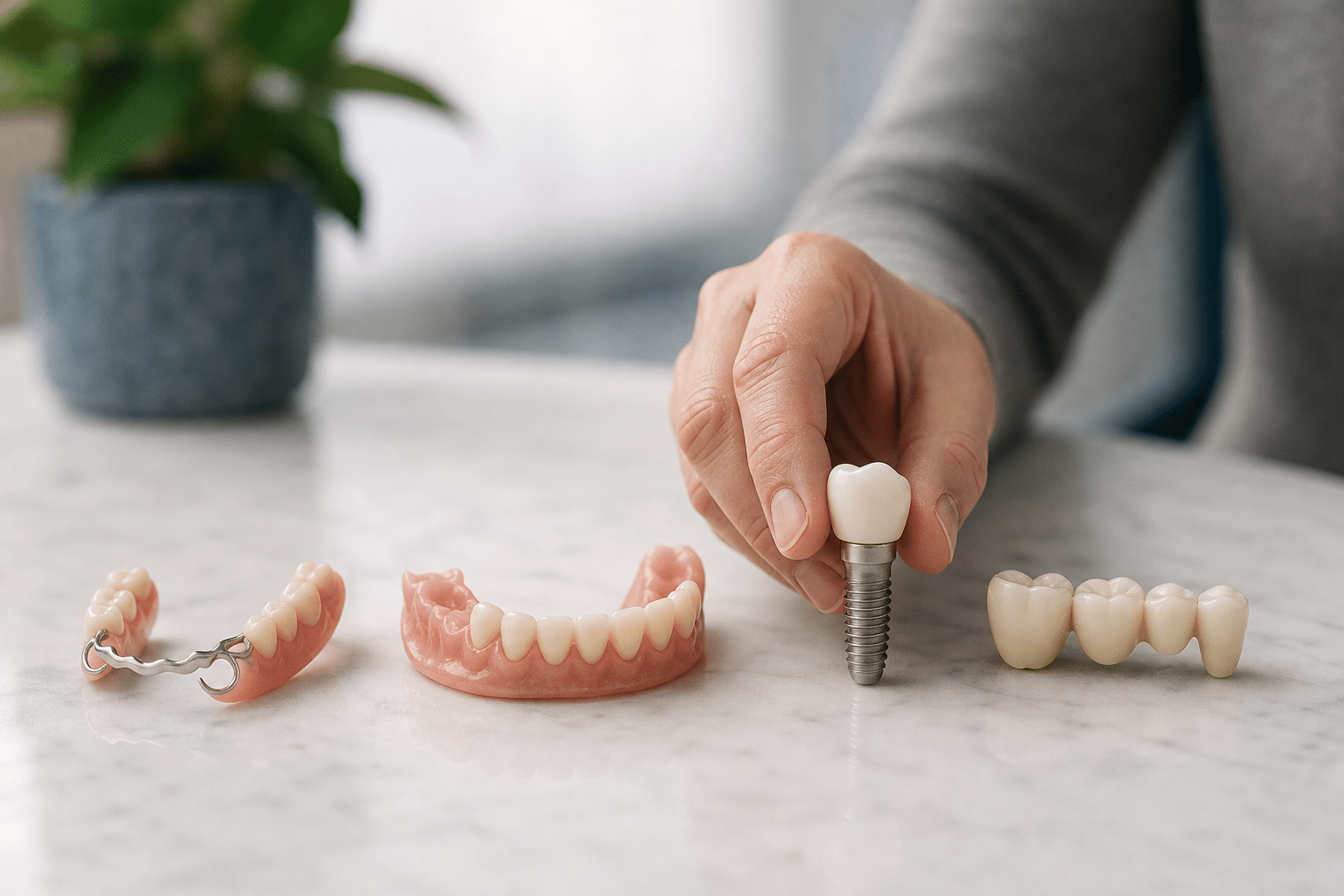
Replacement tooth costs in 2026 range from a few hundred dollars for a removable partial denture to several thousand for a full implant with extraction and bone graft. The right choice depends on how many teeth are missing, the health of your jawbone, and your budget. Dental implants, bridges, and partial dentures each suit different clinical situations, and understanding those differences before you book an appointment saves both time and money. Note that full-arch options such as All-on-4 vary widely by case and are best quoted after a clinical exam.
What Happens If You Leave a Missing Tooth Untreated?
The jawbone beneath a missing tooth begins to shrink within the first year because it no longer receives the stimulation a root provides. Neighboring teeth gradually tilt into the space, and opposing teeth can over-erupt, changing your bite and making future treatment more complex and costly.
According to the American Dental Association's 2024 data via AARP, the average adult has three or more missing or decayed teeth by age 64. That figure reflects how quickly a single untreated tooth can become several. The longer you wait, the more likely you are to need bone grafting or orthodontic work before any replacement option is even possible.
Reviewing the full range of types of tooth replacement options compared is a useful first step before comparing costs, because the clinical situation determines which options are actually available to you.
How Much Does a Single Tooth Replacement Cost in 2026?
Cost varies significantly by option. A dental implant carries the highest upfront price, while a removable partial denture sits at the lower end. The table below shows what each option typically involves, using 2026 figures where supported by research and qualitative descriptors elsewhere.
| Option |
Typical Cost Range (2026) |
Invasiveness |
Longevity |
| Dental Implant (post, abutment, crown) |
$3,760, $5,733 |
Surgical |
20+ years with proper care |
| Dental Implant (with extraction and bone graft) |
$4,929 average when bundled with preparatory work |
Surgical |
20+ years with proper care |
| Fixed Dental Bridge |
Generally lower than implants |
Non-surgical |
10–15 years |
| Removable Partial Denture |
Most affordable upfront |
Non-surgical |
5–8 years |
| Mini Dental Implant |
Lower than standard implants |
Minimally surgical |
Shorter than conventional implants |
| All-on-4® Implants |
Highest cost for full arch |
Surgical |
Long-term fixed solution |
Insurance coverage, geographic location, and whether you need preparatory work such as extractions or bone grafting all affect the final number. Always ask for a written fee estimate before any work begins.
Dental Implants: The Long-Term Standard for Single Tooth Replacement
A dental implant replaces both the root and the visible tooth. A surgeon places a titanium post into the jawbone, then allows it to fuse with the bone over three to nine months in a process called osseointegration [S5]. Once the post is stable, an abutment (the connector piece) and a custom crown are attached [S6]. You can bite and chew with full force, just as you would with a natural tooth.
In 2026, a single implant including the post, abutment, and crown typically costs between $3,760 and $5,733, according to realdentalcosts.com's 2026 data. When extraction and bone grafting are needed first, the average bundled cost rises to around $4,929. Those numbers reflect the procedure's complexity, not a premium for the material alone. Titanium posts are standard; zirconia posts are an alternative for patients with metal sensitivities, and your dentist can explain which suits your case.
The implant's key advantage is jawbone preservation. Because the titanium post mimics a natural root, it keeps the surrounding bone from shrinking. For a detailed walkthrough of the surgical steps, see How is a Dental Implant Placed? Your Step-by-Step Guide. Patients who want to hear real experiences before committing can read Patient Reviews Dental Implant Procedures from people who have gone through the process.
Is a Dental Bridge a Good Alternative to an Implant?
A fixed dental bridge can be a practical choice when surgery is not an option or when the teeth on either side of the gap already need crowns. The bridge anchors an artificial tooth (the pontic) to crowns cemented onto those neighboring teeth, filling the space without any implant surgery.
The trade-off is that healthy adjacent teeth must be reshaped and reduced to accept the crowns, which permanently alters them. A bridge also does not prevent bone loss under the missing tooth because there is no root to stimulate the jaw. Most bridges last 10 to 15 years before needing replacement, so the long-term cost is higher than the upfront price suggests. If you are replacing a back tooth where bite forces are strongest, ask your dentist whether the adjacent teeth can reliably support a bridge.
What Is the Cheapest Option for a Missing Tooth?
A removable partial denture is typically the most affordable upfront path for replacing one or more missing teeth. It uses a gum-colored base with metal or acrylic clasps that attach to remaining natural teeth, and you remove it for cleaning and sleep. The lower cost comes with real limitations: partial dentures are the least stable option, may need periodic adjustments, and have the shortest lifespan of any replacement at roughly five to eight years. Bone loss under the missing tooth continues over time because there is no root present.
Mini dental implants offer a middle ground. They use a narrower post than a standard implant and can often be placed in a single visit without bone grafting. They cost less than conventional implants and work well for smaller teeth or for stabilizing a denture. However, they may not hold up under heavy bite forces, particularly if you grind your teeth, and they are generally less durable than full-size implants.
Dental insurance plans often impose waiting periods before covering major restorative work like bridges or implants. If your plan has one, the timing of enrollment relative to when you need treatment can affect your out-of-pocket cost. Ask your insurer about your specific policy before scheduling.
Replacing Multiple or All Teeth: When All-on-4 Makes Sense
When most or all teeth in an arch are missing, individual implants for each space become impractical. All-on-4® dental implants address this by securing a full arch of fixed replacement teeth using only four strategically angled implants. The angled placement often takes advantage of denser bone areas, which means bone grafting is commonly avoided.
The result provides significantly higher chewing force than traditional dentures and stays fixed in place rather than relying on adhesives. For patients who have been struggling with loose or failing dentures, the stability difference is substantial. Cost varies widely depending on the number of preparatory procedures needed, so ask your dentist for a written fee estimate after a clinical assessment.
Getting Affordable Replacement Teeth in Texas
Affordable Dentist Near Me (ADNM) is an independent, Texas-owned dental group with 17 offices across the Dallas, Fort Worth Metroplex, East Texas, and Central Texas. All offices are open Monday through Friday, 9 AM to 6 PM, with same-day appointments available for new patients and emergencies.
Prices and plan limits verified as of October 2026.
FAQs
How does a dentist replace one tooth?
Replacing a single tooth usually means choosing between a dental implant, a fixed bridge, or a removable partial denture. An implant involves placing a titanium post into the jawbone, allowing it to fuse over three to nine months, then attaching a crown. A bridge anchors an artificial tooth to crowns on neighboring teeth. A partial denture clips onto remaining teeth and is removed for cleaning. Your dentist will assess your bone health and bite before recommending an option.
How many hours does dental implant surgery take?
Placing a single dental implant typically takes one to two hours in the chair, including preparation and anesthesia time. Cases involving extraction or bone grafting on the same visit take longer. The surgical appointment is only one part of the process. The osseointegration phase that follows, where the post fuses with the jawbone, takes three to nine months before the final crown can be attached.
What is the best type of dental implant?
There is no single best type for every patient. Standard titanium implants are the most widely used and have the longest track record for durability. Zirconia implants are an option for patients with metal sensitivities. Mini implants work well for smaller teeth or denture stabilization but may not suit high bite-force areas. The right choice depends on the location of the missing tooth, bone density, and your overall health. Your dentist can review the options with you after an exam and X-rays.
How do dental insurance waiting periods affect the cost of a bridge or implant?
Many dental insurance plans classify bridges and implants as major restorative work and impose a waiting period, often six to twelve months after enrollment, before they contribute to the cost. If you need treatment before that period ends, you pay out of pocket for the full amount. Checking your plan's waiting period before scheduling lets you time treatment to maximize your benefit, or explore financing options to cover the gap.
Can a removable partial denture be upgraded to an implant later?
Yes. A partial denture is sometimes used as a temporary or transitional solution while you save for an implant or while the jawbone heals after an extraction. Moving from a partial to an implant later is possible, though your dentist will need to reassess bone density at that point. Extended time without a root in place can cause bone shrinkage that may require a graft before implant placement. Discussing the long-term plan early helps you avoid extra procedures down the road.
Conclusion
Replacement tooth costs in 2026 range from the most affordable removable partial denture to a full implant with extraction and bone graft at the higher end. Implants preserve jawbone and last the longest. Bridges and partial dentures cost less upfront but carry trade-offs in longevity and bone health. The cheapest option today is not always the cheapest option over ten years.
The most useful next step is a clinical exam that tells you which options your jawbone and bite can actually support. From there, ask for a written fee estimate and check your insurance plan's waiting period before committing to a timeline.