Yes, you can finance dental implants with bad credit, but approval depends on the lender’s requirements, your credit history, your income, and the amount you need to borrow. Approval does not mean the payments fit your budget, and interest or fees can increase what you repay. In 2026, start with a written treatment plan, ask which payment arrangements the dental office accepts, and check the credit-inquiry rules before applying.
TL;DR
Dental implants financing bad credit: approval is possible, but the lender decides eligibility and repayment terms.
Affordable Dentist Near Me provides dental implant care; confirm payment arrangements with your chosen office.
Compare dental financing by total repayment, interest rules, fees, and credit checks—not monthly payment alone.
Ask your dentist about safe treatment timing before delaying care or borrowing more than you can repay.
Can you finance dental implants with bad credit?
Bad credit does not automatically rule out dental implant financing. It also does not guarantee approval through a dental office or an outside lender. Each financing agreement has its own eligibility rules, and the dental practice’s acceptance of a payment method is separate from the lender’s decision.
Affordable Dentist Near Me provides dental implant care for families in Fort Worth, Dallas, Houston, Waco, Grand Prairie, and Crowley. Ask your chosen office which payment methods it accepts before submitting an application elsewhere.
Start by distinguishing borrowing from paying for treatment in stages. Borrowing creates a repayment obligation to a lender. Paying the practice as treatment progresses follows a different arrangement, if the practice offers it. Neither should be assumed from an advertisement that says payment options are available.
Payment route to ask about
Best for
Main advantage
Main limitation
Third-party dental financing
Patients comparing a dedicated treatment-credit offer
Can spread repayment across an agreed schedule
Approval, interest, fees, and participating-office rules apply
Personal loan
Patients comparing borrowing independently of the dental office
Lets you evaluate a separate lender’s written terms
Bad credit can restrict eligibility or lead to less favorable terms
Office payment arrangement, if offered
Patients who want to discuss payments directly with the practice
Can clarify how payments relate to treatment stages
Availability, eligibility, and payment deadlines depend on the office
Savings combined with verified benefits
Patients seeking to limit borrowing
Reduces the amount that needs financing
Saving takes time, and insurance coverage depends on the plan
Use the dental implant financing options comparison to organize your questions. Treat the lender’s current written agreement—not a general description—as the source for the terms you would accept.
Why this matters
Dental implant financing involves two separate decisions: whether implants fit your dental needs and whether the repayment agreement fits your household budget. A lender evaluates borrowing eligibility. Your dentist evaluates your mouth, treatment options, and clinical risks.
For a 2026 application, keep those decisions separate. A financing offer should not push you toward more treatment than your dentist recommends, and a credit denial should not stop you from asking about necessary care.
Choose treatment with your dentist, then choose how to pay for that treatment. Reversing that order risks building your dental plan around a credit limit instead of your health needs.
Third-party dental financing: check the actual agreement
Third-party dental financing can let you repay treatment expenses over time. Before applying, ask whether your dental office accepts the specific financing arrangement and whether the lender checks your credit during eligibility screening, application, or both.
Read beyond the advertised payment. Check the annual percentage rate, fees, repayment schedule, and consequences of missing a payment. If the agreement includes a promotional period, identify exactly what happens when it ends.
Deferred interest is not the same as interest being permanently waived. Under a deferred-interest agreement, failing to meet the stated payoff conditions can trigger interest calculated from the original purchase date. The contract determines those conditions; do not assume making the minimum payment will satisfy them.
Keep a copy of the agreement before treatment begins. If you cannot explain the interest rule in plain language, ask the lender to explain it before you accept.
Personal loans: compare repayment, not just approval
A personal loan is another borrowing route to investigate. Its eligibility requirements and repayment terms belong to the lender, not the dental practice, so confirm how the loan proceeds would reach you and how the office expects payment.
For a 2026 comparison, examine the amount you receive after any upfront deductions, the required payment, the repayment period, and the total you would repay. Check late-payment rules and whether the agreement charges for paying the loan off early.
A lower monthly payment can come from extending the repayment period rather than improving the deal. Compare the full obligation before choosing the smallest monthly payment. Approval is useful only when the agreement leaves room for your essential household expenses.
Avoid submitting applications simply to see who says yes. First ask which steps involve a soft inquiry and which involve a hard inquiry, then decide which offers justify a formal application.
Office payment arrangements: ask, do not assume
Some dental practices offer payment arrangements directly, but that does not establish what any particular office provides. Ask whether payments can follow treatment stages, whether credit screening is required, and whether treatment must be paid for before each stage begins.
Get the arrangement in writing. It should identify the covered treatment, payment deadlines, applicable fees, and what happens if your treatment plan changes. Ask who handles the account: the practice itself or a separate financing company.
An arrangement described as “in-house” is not automatically free of credit checks or borrowing costs. The written terms determine your obligation, not the label. If the office does not offer a suitable arrangement, ask your dentist about treatment alternatives rather than assuming an outside loan is your only next step.
Why dental implant financing approval varies
Bad credit is a broad description, not a single lending rule. These factors help explain why different applicants receive different decisions:
Credit history: Lenders assess information in your credit file, including payment history and existing accounts.
Income: A lender can require evidence that you can meet the proposed repayment obligation.
Existing debt: Current payments affect how much additional borrowing fits your finances.
Requested amount: Borrowing for the full treatment plan differs from borrowing only the balance after savings or verified benefits.
Lender requirements: Each lender sets its own application and eligibility criteria.
Additional applicant rules: A co-applicant or co-signer is relevant only if the lender permits that arrangement.
There is no universal credit-score cutoff that applies to every dental implant financing agreement. Ask the specific lender about its requirements rather than treating an online approval claim as a rule.
How do you prepare before applying?
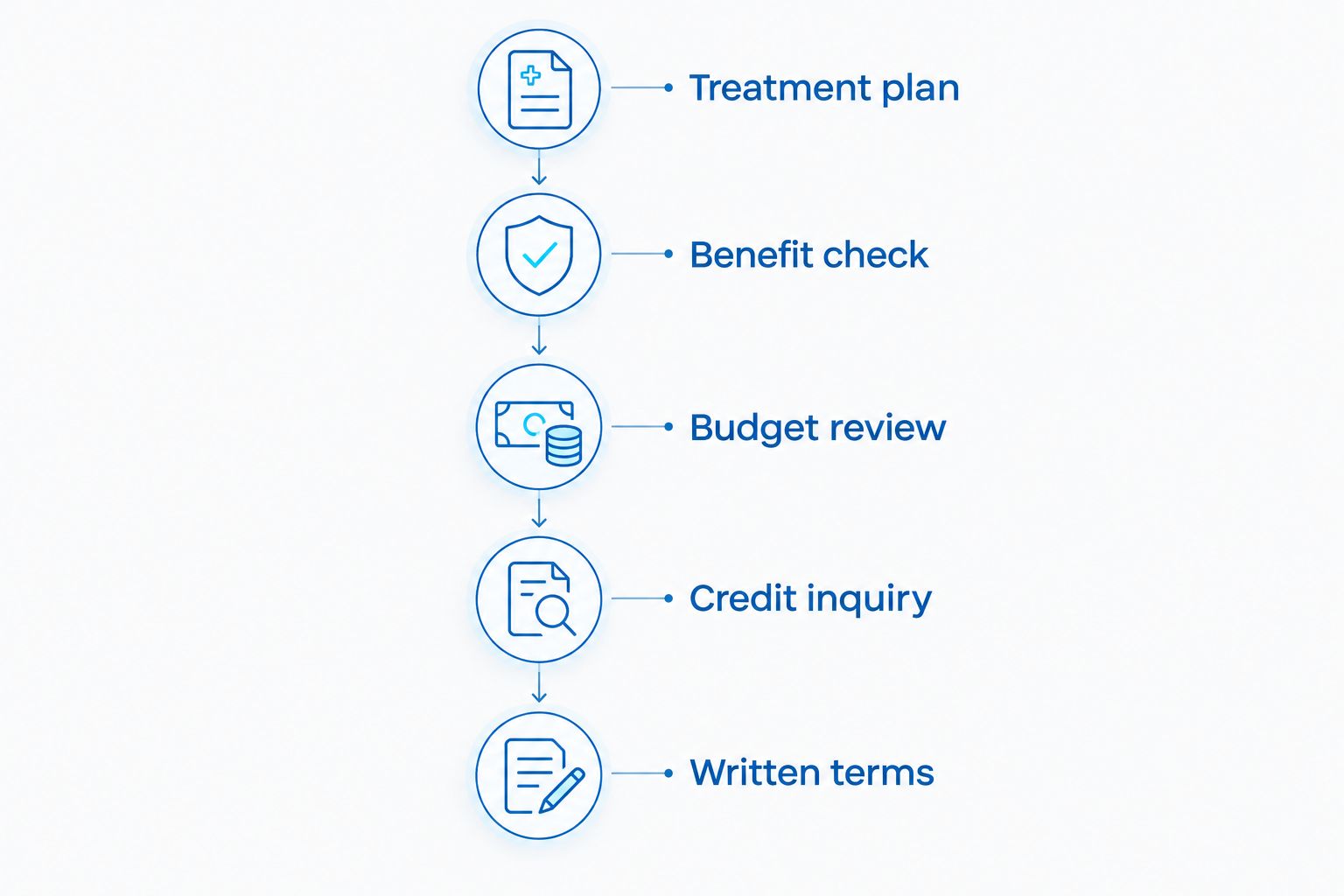
Use this sequence to keep your treatment needs and borrowing decisions aligned. It also gives you a clear stopping point if an offer does not fit your budget.
Treatment plan: Ask your dentist for a written plan identifying the proposed implant treatment and any preparatory care. Confirm what is included and what would require a separate decision.
Benefit check: Ask your insurer about the specific proposed procedures, exclusions, waiting periods, and remaining benefits. Do not subtract an assumed insurance contribution from your borrowing needs.
Budget review: Review take-home income alongside housing, food, transport, existing debt, and other essentials. Leave room for follow-up dental care rather than committing every remaining dollar.
Credit inquiry: Ask the lender whether checking eligibility affects your credit file and whether accepting an offer requires a separate inquiry.
Written terms: Compare repayment obligations and keep copies before signing. Confirm when payments begin and what happens if treatment changes or stops.
Your written dental plan is the starting document. Without it, you risk applying for an amount that excludes a necessary part of treatment or borrowing for care you have not agreed to receive.
Confirm the treatment and your budget before accepting financing.
Ask how the office handles changes before authorizing treatment. The financing agreement and the dental treatment agreement are separate documents; understand both, including cancellation and refund procedures that apply to your situation.
Can a co-signer help you qualify with bad credit?
A co-signer can support an application only when the lender allows co-signers and approves the application. A co-signer also takes on responsibility for the debt under the agreement; this is not just a personal reference.
Before involving a relative or friend, explain the repayment obligation and ask the lender how missed payments affect each person. Confirm whether the lender uses a co-signer arrangement or a joint application, because the responsibilities depend on the contract.
Do not use a co-signer to make an unaffordable payment look affordable. Another person’s willingness to help does not change the amount your household can reliably repay.
Can you finance dental implants without a credit check?
You can ask about arrangements that do not involve credit screening, but “no credit check” does not establish that an offer is affordable or suitable. Review the payment schedule, fees, late-payment consequences, and identity of the company collecting payments.
For any 2026 offer, separate the screening claim from the repayment terms. Ask whether the arrangement is a loan, a payment agreement with the practice, or another financial product.
Do not pay someone for a promise of guaranteed approval. Verify the company and obtain the agreement before sharing sensitive financial information or authorizing a payment.
What should you do if dental implant financing is denied?
If financing is denied, read the lender’s notice and review the stated reasons before applying elsewhere. When a credit report contributed to the decision, follow the notice’s instructions for obtaining the report and checking it for errors.
Then return to the treatment plan. Ask your dentist whether safe staging, a different tooth-replacement approach, or saving before elective treatment fits your needs. Staging does not mean dividing treatment yourself; the dentist must determine which steps belong together.
If you have severe pain, spreading swelling, fever, or trouble swallowing or breathing, seek prompt care rather than waiting for financing approval. Trouble breathing or swallowing requires emergency attention.
Where should Texas families start?
Affordable Dentist Near Me is a local dental implant care option for families in the Texas cities it serves. Start with a dental evaluation and ask the chosen office for current payment information; the practice’s services do not establish lender approval or a particular financing program.
The benefit of that conversation is a treatment plan tied to your dental needs. The limit is equally important: a dental evaluation cannot guarantee a borrowing decision. Ask separate questions about treatment suitability, office payment policies, and lender eligibility.
Start with your dental treatment questions
Ask about dental implant care and confirm payment arrangements with your chosen office.
Can I get dental implant financing if I have bad credit?
Yes, approval is possible with bad credit, but each lender sets its own eligibility requirements. Confirm repayment terms and accepted payment methods before committing to treatment.
What credit score do I need to finance dental implants?
There is no universal credit-score requirement for dental implant financing. Ask the specific lender about its criteria and whether checking eligibility involves a hard credit inquiry.
Does applying for dental implant financing affect my credit?
A formal application can involve a hard credit inquiry, while some eligibility checks use soft inquiries. Ask the lender which inquiry applies at each step before submitting your information.
Can a co-signer help me finance dental implants?
A co-signer can help only if the lender accepts co-signers and approves the application. The co-signer assumes responsibility under the agreement, so both people should understand the repayment terms.
Is no-credit-check dental financing a better choice?
No-credit-check financing is not automatically a better choice. Compare its fees, payment schedule, late-payment rules, and total repayment obligation against other arrangements you qualify for.
Does dental insurance cover implants before I apply for financing?
Dental implant coverage depends on your insurance plan and the proposed procedures. Verify exclusions, waiting periods, remaining benefits, and the insurer’s estimate before deciding how much to borrow.
Does Affordable Dentist Near Me guarantee financing with bad credit?
Dental implant care at Affordable Dentist Near Me does not establish guaranteed financing approval. Confirm current payment arrangements with your chosen office and eligibility requirements with the lender.
One last thing
Before accepting a 2026 financing offer, ask: “What happens to this debt if my treatment plan changes?” A clinical change does not automatically cancel a borrowing agreement, and a refund from the practice does not necessarily close the financing account.
Get the cancellation, refund, and account-adjustment process in writing. Knowing who handles each step is just as important as knowing when your first payment is due.