Best overall: a dentist your Medicaid plan confirms for your adult benefit. Best budget alternative: a community health center with dental services. Best for supervised teaching-clinic care: a dental school. If you’re searching for a dentist that takes medicaid near me in Texas in 2026, start with coverage verification—not a map listing.
TL;DR
For a dentist that takes medicaid near me, confirm adult benefits before choosing an office.
Texas Medicaid does not provide a broad, routine dental benefit for most adults aged 21 and older.
Community health centers and dental schools are alternatives, not automatic Medicaid-covered options.
Affordable Dentist Near Me offers general and restorative dental care; confirm Medicaid participation with the specific office.
Why this matters
A dentist accepting Medicaid does not mean Medicaid covers your treatment. You need both a covered service and a participating provider for your specific program. A directory entry alone answers neither question completely.
Texas adult dental coverage differs from children’s coverage. Federal Medicaid rules require dental benefits for eligible members younger than 21 years through Early and Periodic Screening, Diagnostic, and Treatment services. Texas does not provide the same broad routine dental benefit to most members aged 21 years and older.
Affordable Dentist Near Me provides general, cosmetic and restorative dental care in Fort Worth, Dallas, Houston, Waco, Grand Prairie and Crowley. Treat it as a local practice to evaluate—not as a confirmed Medicaid provider without office-level verification.
What makes the best adult Medicaid dental option?
Use these criteria before choosing where to seek care in 2026:
Adult eligibility: The office must check your actual benefit, not assume children’s dental coverage applies.
Plan participation: Confirm the treating dentist and location participate in the program responsible for your care.
Treatment coverage: Ask about the examination and proposed treatment separately. One answer does not establish both.
Financial clarity: Request a written treatment plan that identifies covered and noncovered services before you agree.
Practical fit: Consider travel, accessibility, follow-up visits and whether the office handles your dental concern.
The strongest option passes all five checks. A nearby office that cannot confirm your benefit is not a better choice than an office farther away that can explain the covered treatment pathway.
Texas adult dental options at a glance
These are ranked care pathways, not a ranking of insurance companies. Your eligibility determines which pathway belongs first.
Rank and option
Best for
Standout feature
Key limitation
1. Plan-confirmed participating dentist
Adults with a verified dental benefit
Connects benefit verification with a participating office
Participation does not make every procedure covered
2. Community health center
Adults needing an income-based alternative
Health centers use sliding-fee policies for eligible patients
Not every center offers dental services or every procedure
3. Dental school clinic
Adults comfortable with supervised teaching care
Dental students provide care under faculty supervision
Teaching appointments can take longer
4. Private dental practice
Adults seeking general or restorative care outside a confirmed benefit
Direct discussion of diagnosis and treatment choices
Medicaid participation and coverage require separate confirmation
1. Plan-confirmed dentist: best for verified adult Medicaid benefits
A plan-confirmed dentist is the first choice when your Medicaid program includes the service you need. Start with the member-services number on your coverage card and request help identifying an adult dental provider for that specific service.
For your 2026 visit, ask whether the benefit comes through your health plan, another program administrator or a separate arrangement. Then have the dental office verify the information against your member record.
Plan-confirmed dentist pros:
Starts with your actual eligibility rather than a general advertising claim.
Helps identify the correct provider network for your benefit.
Gives you a place to ask about referrals or prior approval.
Separates covered treatment from services you must discuss independently.
Plan-confirmed dentist cons:
A participating office cannot expand your Medicaid benefits.
A directory listing does not establish that a particular treatment is covered.
Approval requirements can add steps before treatment begins.
Best for: Adults whose program confirms a dental benefit relevant to their condition.
If the office says it accepts Medicaid, follow up with the exact program name and your age. Ask whether the dentist treats adult members under that program, not simply whether the practice treats children with Medicaid.
Verdict: Choose this pathway first when your specific adult benefit is confirmed.
2. Community health center: best for income-based dental access
Community health centers are an alternative when you need dental care that your Medicaid benefit does not cover. Federally funded health centers use sliding-fee policies based on income and family size, but dental services differ by location.
Ask whether the center has an adult dental clinic and whether it handles your concern. Do not assume a health center with medical services also provides fillings, extractions or dentures.
Community health center pros:
Provides an income-based route to care for eligible patients.
Offers an alternative when insurance does not cover the needed treatment.
Gives you a defined application process for financial assistance.
Community health center cons:
Dental services and treatment scope differ between centers.
You must provide the documentation required by the center.
Sliding-fee eligibility is separate from Medicaid coverage.
Best for: Adults seeking an income-based alternative for uncovered dental care.
Before scheduling, ask what documents establish household income and whether the proposed treatment falls under the center’s assistance policy. Also ask where the center refers patients when treatment exceeds its dental services.
Verdict: Choose a community health center when income-based assistance matters more than staying within a particular private practice.
3. Dental school clinic: best for supervised teaching care
A dental school clinic provides treatment in a teaching setting, with students working under licensed faculty supervision. Some schools also operate advanced training clinics, which have different screening and treatment processes.
This is an alternative care setting, not an automatic Medicaid benefit. Ask the specific clinic about adult Medicaid participation, patient screening and the dental problem you need treated.
Dental school clinic pros:
Includes faculty supervision during student-provided treatment.
Provides a structured assessment and treatment-planning process.
Offers another place to seek care when your usual options do not fit.
Dental school clinic cons:
Teaching appointments can take longer than conventional visits.
Screening determines whether the clinic can accept your case.
Different departments can require separate treatment arrangements.
Best for: Adults who can accommodate teaching appointments and follow-up visits.
For a 2026 treatment plan, discuss the full sequence before committing. Ask whether the same clinic can complete your care and what happens if another department or an outside specialist becomes necessary.
Verdict: Choose a dental school when the teaching format fits your schedule and the clinic accepts your treatment needs.
4. Private practice: best for care outside a confirmed benefit
A private dental practice is another route when your Medicaid program does not cover the treatment you need. The dentist can examine the problem, explain treatment choices and identify which care is urgent versus which care can be planned.
Affordable Dentist Near Me fits Texas adults seeking general and restorative dental care in its listed service cities. Its stated services include implants, crowns, braces and teeth whitening; that service list does not establish Medicaid coverage or participation.
Private dental practice pros:
Lets you discuss the diagnosis and treatment choices directly with a dental team.
Provides a setting for general and restorative dental care.
Allows you to request a written plan separating immediate needs from later treatment.
Private dental practice cons:
Services outside your benefit need a separate financial arrangement.
An advertised service does not establish that Medicaid covers it.
Acceptance must be checked for the specific office and treating dentist.
Best for: Adults comparing private care after establishing their coverage limits.
Before visiting Affordable Dentist Near Me, ask the specific office whether it participates in your exact adult Medicaid program. If it does not, request an explanation of the examination and treatment process before agreeing to care.
Verdict: Choose private care after you understand what your benefit excludes and what treatment you are authorizing.
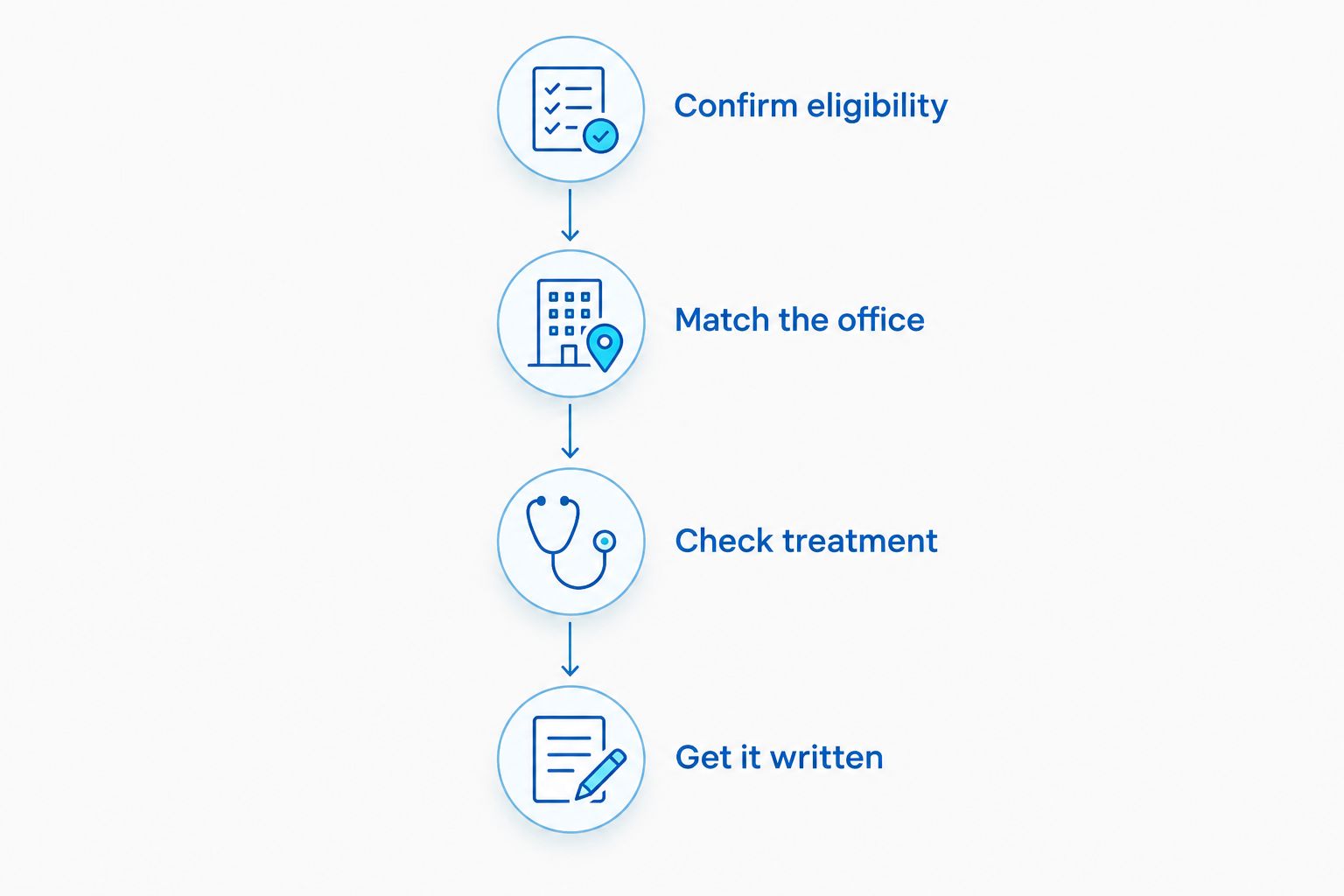
How to verify an office before your visit
Use this sequence for any Texas office in 2026. Keep the plan’s answer and the dental office’s answer together so you can resolve conflicting information before treatment.
Confirm eligibility
Have your member card ready and ask the program administrator whether your adult coverage includes the service you are seeking. If you do not yet know the diagnosis, ask how coverage works for the initial dental assessment.
Match the office
Give member services the dentist’s name and the exact office location. Then ask the office to check the same program; recognition of an insurer’s name alone is not enough.
Check treatment
After the examination, ask the dental team to identify the proposed procedures. Have the office explain which services require approval and which are outside your benefit.
Get it written
Request a written treatment plan before authorizing nonurgent work. Keep any benefit explanation, approval notice and member-services reference information with that plan.
Verify the benefit and the office before agreeing to treatment.
When you call, ask these questions plainly: Does this office treat adults under my exact program? Is the examination covered? Who checks approval for the treatment? What happens if the benefit does not cover the recommended procedure?
The order prioritizes verified benefits, financial clarity and a suitable care setting. A participating dentist ranks first only when the adult benefit covers the relevant service; community clinics and dental schools provide alternatives when that route does not fit.
This is not a quality ranking of individual dentists. Compare the diagnosis, explanation of alternatives and written treatment plan at every office, including Affordable Dentist Near Me.
Which Texas dental option should you choose?
Start with your Medicaid program, not a list of dentists. If the program confirms an adult dental benefit, request a participating provider for the needed service. If it does not, compare a community health center, dental school clinic and private practice using the same written-plan checklist.
Do not choose an extraction, crown or other procedure solely because you believe one option is covered. Ask the dentist to explain the clinical alternatives and the consequences of delaying care before making your decision.
FAQ
How do I find a dentist that takes Medicaid near me for adults?
Start with the member-services number on your Medicaid card and request an adult provider for the service you need. Confirm the exact office, treating dentist and benefit with both the program and the dental office.
Does Texas Medicaid cover routine dental care for every adult?
No. Texas Medicaid does not provide a broad routine dental benefit to most adults aged 21 and older. Ask your program administrator about benefits tied to your specific eligibility or program.
Do Medicaid dental rules change when I turn 21?
Yes. Federal Medicaid dental requirements for eligible members younger than 21 differ from adult benefit rules. If you are aged 18–20, ask about your benefits under Early and Periodic Screening, Diagnostic, and Treatment services rather than assuming the adult rules apply.
Does Affordable Dentist Near Me accept adult Medicaid?
Confirm adult Medicaid participation directly with the specific office. The practice’s listed services and locations do not establish acceptance of your program or coverage for your treatment.
Is a community health center the same as a Medicaid dental office?
No. A community health center is a care setting, while Medicaid is a coverage program. Ask separately about adult dental services, Medicaid participation and income-based assistance.
Does a dentist accepting Medicaid mean my dentures or implants are covered?
No. Provider participation and procedure coverage are separate questions. Ask your program and the dental office to verify the specific treatment before you authorize it.
Should I wait for coverage verification if my face is swelling?
Do not delay urgent assessment for facial swelling. If swelling affects breathing or swallowing, seek emergency medical care immediately; a hospital evaluation does not replace follow-up dental treatment.
One last thing
The most useful question is not simply whether an office takes Medicaid—it is whether your benefit covers the care you need there. Save that question with your member card and ask it at every new office.
For 2026, use Texas Health and Human Services’ Medicaid dental guidance and your program’s current member materials for state coverage questions. Federal Medicaid’s Early and Periodic Screening, Diagnostic, and Treatment guidance explains the under-21 dental requirement; neither replaces an individual benefit check.